Art Deco is a hundred years old, and it's in great shape.
· 1 min read
The Musée des Arts Décoratifs is proving it right now, on rue de Rivoli, with a retrospective of nearly a thousand works devoted to the centenary of the 1925 International Exhibition. Furniture, jewelry, textiles, lacquerware, the Orient Express reconstructed in the nave. You come away with one certainty: this style has not survived a century because it is nostalgic. It has survived because it rests on something more solid than fashion.
That something is geometry. Not as a decorative motif. As a system of thought.
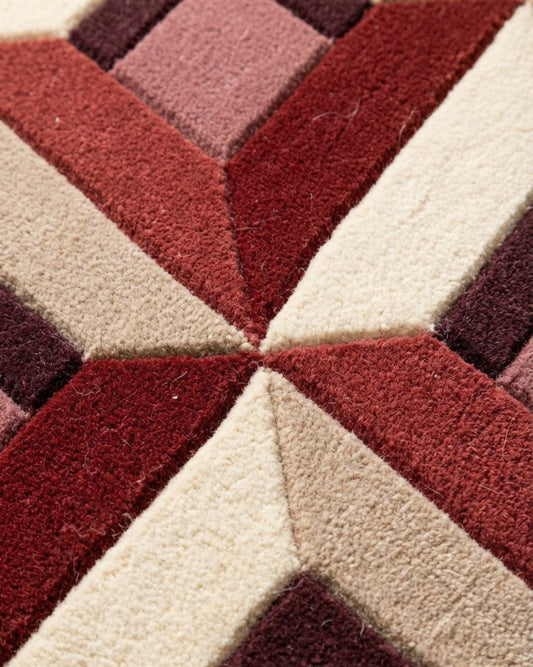
Art Deco was born of a refusal. A refusal of the soft curve of Art Nouveau, a refusal of ornament for ornament's sake. What made it last is that it replaced decoration with structure. A chevron is not a motif applied to a surface. It is a direction given to space. Lines radiating from a center form a hierarchy. Strict symmetry is an architecture in its own right, independent of the walls.
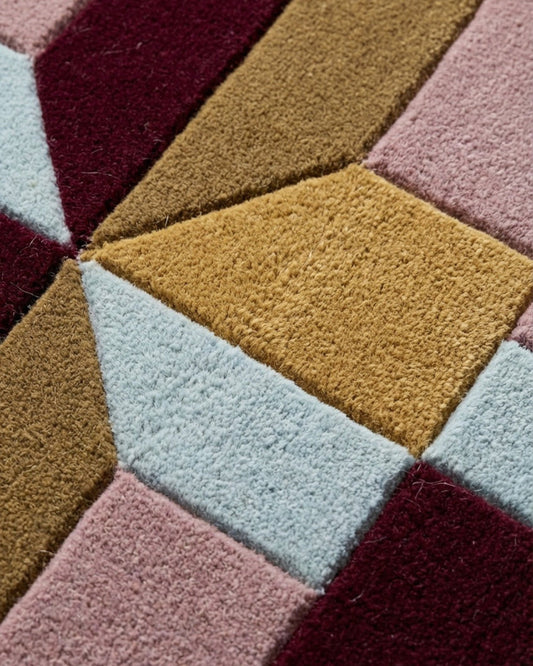
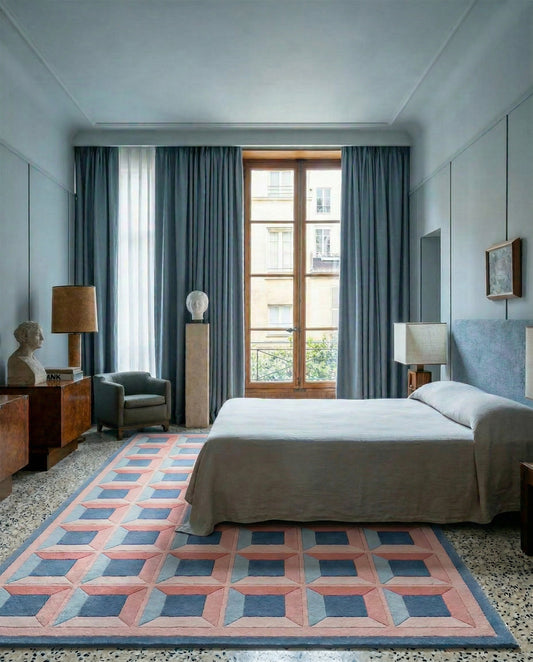
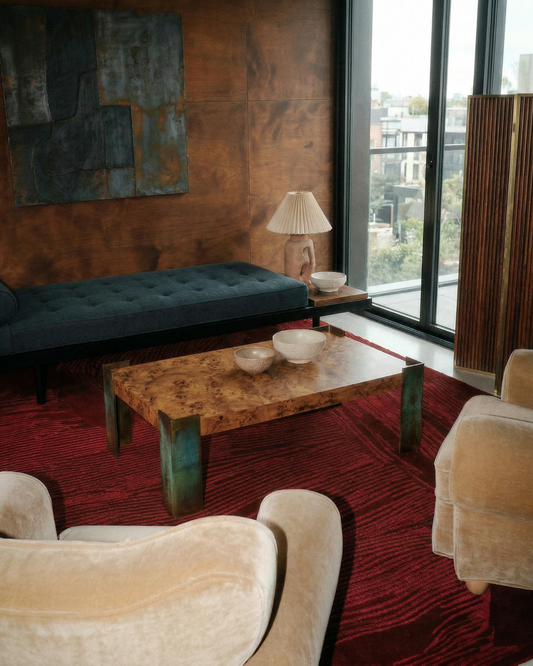
This is why the rug is perhaps the most fitting medium for this vocabulary. On the floor, geometry works without competing for space with the other elements. It organizes, it anchors, it gives the room a scale. In a Haussmann-era apartment, a radiating motif enters into conversation with the chevron parquet without copying its logic. In a sleeker contemporary interior, it introduces a graphic tension that twenty carefully matched cushions will never produce.
Reinterpreting Art Deco today does not mean redoing the 1920s. The gilding, the shagreen and the ivory cigarette holders can stay in the cloakroom. What remains when you take away the period is a system: balance, contrast, repetition. Principles that belong to no fashion because they respond to a spatial logic older than all fashions.
A rug can be geometric and understated. Structuring without being overbearing. Rooted in a century-old tradition and perfectly at home in a 2025 interior. This is not a contradiction. It is exactly what makes this style so hard to exhaust.