What the floors of Venetian palaces have always known how to do
Optical Palazzo is born from a conviction: that trompe l'oeil is not an artifice, but a form of decorative intelligence.
Mosaic as an architecture of perception
In Venetian palaces, floors are not mere surfaces. They are spaces. For centuries, mosaics have been used not to decorate a background, but to construct depth, to create volume where none exists, to suggest an interior architecture for a room that already possesses one.
The geometric patterns covering the floors of the Doge's Palace, St. Mark's Basilica, or the grand residences of the Grand Canal are not simple ornamentation. They are based on a science of perspective applied horizontally: cubes in axonometric view that seem to rise, interlocking hexagons that create an illusion of depth, converging lines that expand or contract space depending on the viewing angle.
This is a tradition that spans centuries without diminishing, because it is based on something invariant: the way the human eye constructs what it sees.
Trompe l'oeil as a discipline
Italy has made trompe l'oeil a culture. Not a parlor trick, but a serious reflection on representation and matter. The master decorators of past centuries who painted marble columns on ordinary plaster, who opened fictitious windows onto non-existent gardens, who extended a ceiling with a painted sky, were not trying to deceive. They sought to enrich.
What a good trompe l'oeil produces is not illusion, but suspension: a moment where the gaze hesitates, where certainty slightly wavers, and where the space around oneself seems a little less fixed than it was.
Vasarely and Op Art: when painting re-examines the question
Five centuries after the Venetian mosaicists, Victor Vasarely poses exactly the same question with different tools. His canvases from the 1960s, like those of Bridget Riley or José-Maria Yturralde, represent nothing. They act. Vibrating squares, swelling spheres, undulating grids: Op Art treats the painted surface as an optical device, whose subject is perception itself.
What connects these two seemingly distant traditions is precisely what interests Rugier. Neither seeks to depict the world. Both seek to modify the way we see it. Mosaic does so with marble and time, Op Art with paint and mathematical rigor.
In both cases, geometry is not a motif. It is a mechanism.
Optical Palazzo
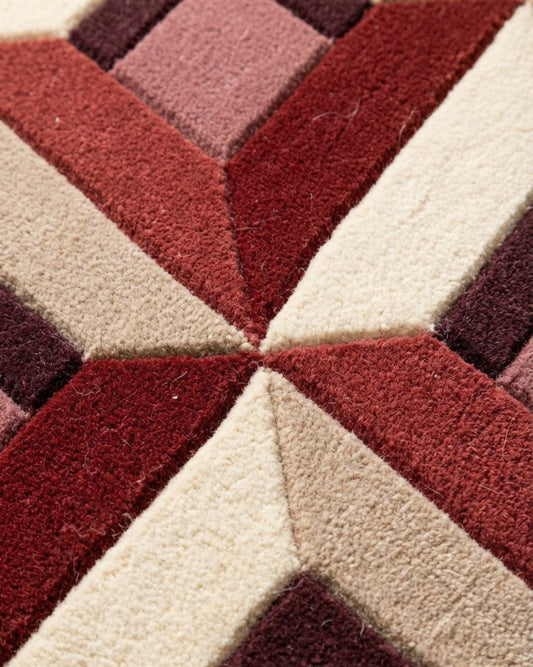
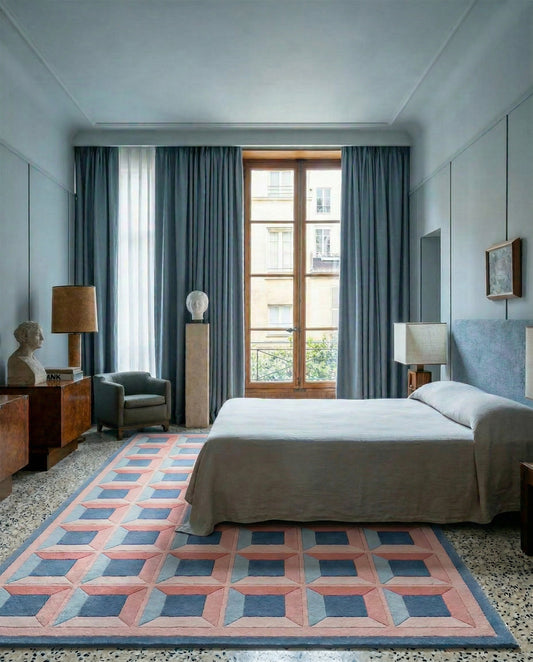
The Optical Palazzo collection draws from these two legacies simultaneously. From Venetian floors, it retains the architectural logic of the pattern, its ability to transform a space. From Op Art, it retains graphic radicalism, the trust in pure geometry as a sufficient language.
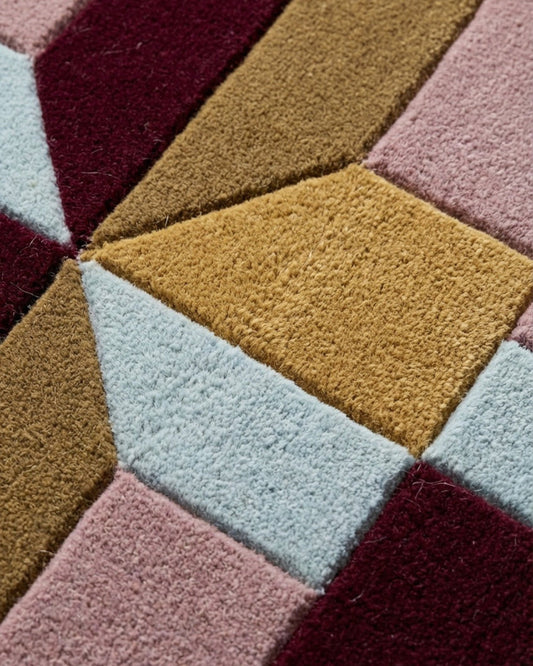
It does not quote them. It continues them, in hand-tufted New Zealand wool, with carving as the final touch: lightly carving the contours so that the cast shadows accentuate what the geometry already suggests. The tessera becomes pile. Vasarely's canvas becomes floor. The effect, however, remains.
A rug that makes a room move without one knowing exactly why.
Optical Palazzo is available in several sizes and colors. Each piece is custom-made in Bhadohi, India, using New Zealand wool.