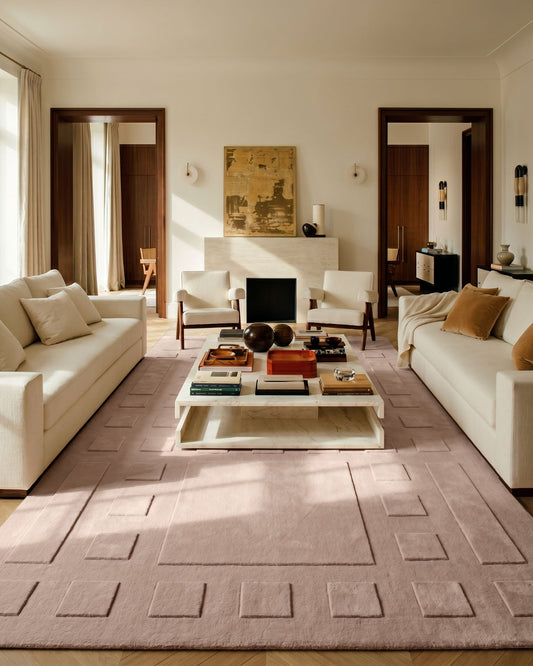
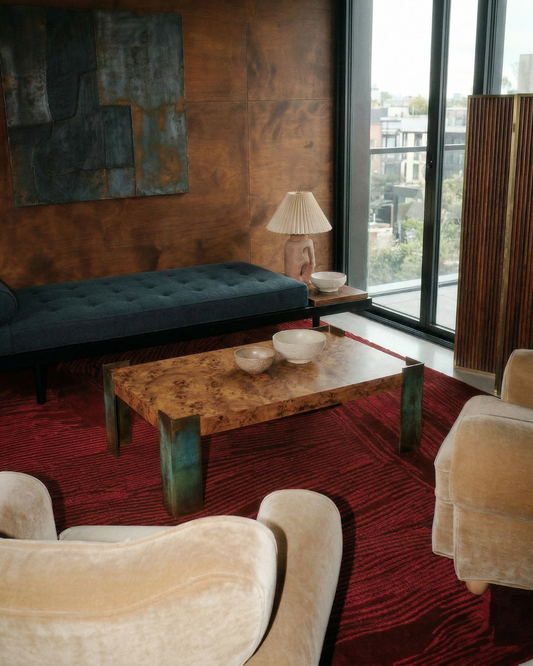
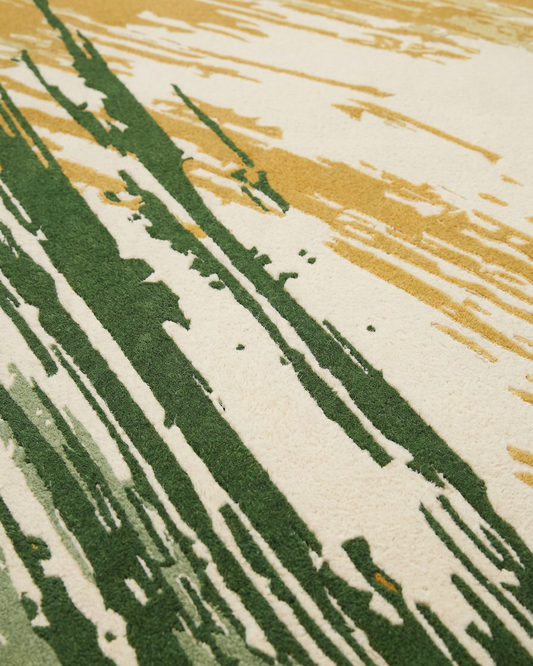
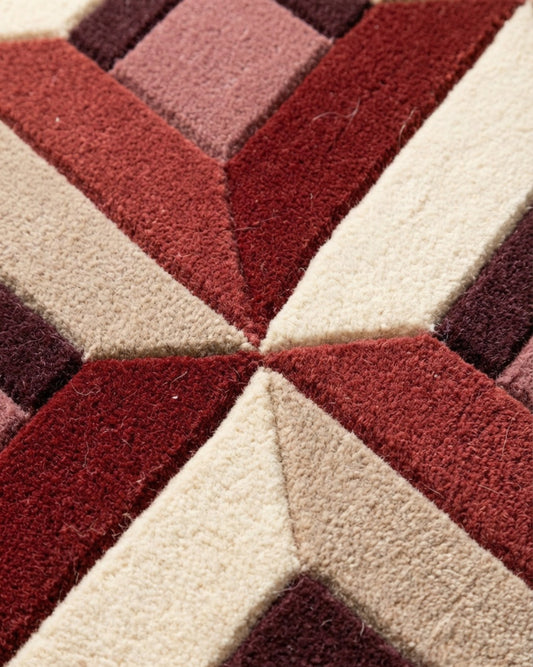
Carving means cutting the pattern directly into the depth of the wool, hollowing out grooves between areas of pile. The resulting relief works like a bas-relief: it only truly shows under raking light, which casts shadows along the cut edges. It is a manual gesture, carried out with curved shears after tufting.
A tufted rug starts as a uniform surface: thousands of wool loops or strands, all cut to the same height, form an even pile. Carving comes next. The artisan cuts into this surface to create changes in level, separating the motifs with clean grooves and lowering some areas below others. The rug then stops being an image laid flat: it becomes a modeled surface, whose design reads as much through shadow as through color.
The La Pintura collection rests entirely on this principle. The pattern is not only dyed into the wool, it is physically cut into its depth. Understanding carving means going back to a tradition far older than the contemporary rug: bas-relief, a way of sculpting that has run through the history of art without ever fully leaving the surface.
Bas-relief: sculpting without leaving the wall
Bas-relief is a form of sculpture in which the figures remain attached to their background and emerge from it only slightly. It is found on Egyptian temples, on Greek friezes such as that of the Parthenon, and on Roman columns such as Trajan's Column, where hundreds of figures recount a military campaign while barely standing out from the stone. The Italian Renaissance made it a major art: on the doors of the Florence Baptistery, Lorenzo Ghiberti created an illusion of depth with a few millimeters of bronze.
What these works have in common is their dependence on light. A flat bas-relief without shadow disappears; lit from the side, it reveals every edge, every hollow, every suggested volume. The sculptor therefore does not only work the material, but anticipates how light will travel across it. This is exactly the logic that carving transposes into wool.
How relief is cut into wool
It all begins with tufting. In Bhadohi, in northern India, the artisan shoots New Zealand wool through a stretched cloth, strand by strand, following a design transferred onto the backing. This stage produces the raw pile, dense and uniform. Only once this surface is in place can carving begin.
The main tool remains the curved shears, handled by hand. The artisan follows the contours of the motif and tilts the blade to cut bevels along the lines, hollowing out grooves that isolate each shape. Where two colors meet, one is lowered slightly so that the other seems to come forward. The gesture requires a steady hand: wool cannot be glued back, and a cut that is too deep or badly placed remains visible. There is no going back.
Precision is a matter of millimeters. A groove that is too timid will not catch the shadow and the motif will remain blurred; a groove that is too deep creates an abrupt break. The artisan looks for the right angle, one that gives a sharp but fluid edge, able to follow a curve without jolts. On a complex pattern, this cutting work can take as much time as the tufting itself.
Why raking light brings out the pattern
A carved rug changes appearance with the time of day and the orientation of the room. Under overhead light, falling vertically, the reliefs cast little shadow and the design fades. Under raking light, the light of morning or late afternoon, of a side window or of low lighting, every groove fills with shadow and every edge catches the light. The pattern then stands out clearly.
Wool has a quality that stone does not: its fibers reflect light differently depending on their angle. An area cut on the bevel does not return light the way an area left flat does, so the relief is doubled by a variation in sheen.
This explains why a carved rug never quite photographs the way it looks. Perception depends on the movement of the eye and the path of the light over the course of the day. Two people seated on either side of the same room do not read exactly the same design. This mobility is what defines relief: it brings the rug closer to a sculpture, whose reading changes as you walk around it.
A craft at floor level
Placing relief on the floor means thinking about a particular point of view. A rug is rarely seen in profile; we look down on it, walk on it, see it from receding angles. Carving works with this constraint through changes in level that read from above as well as at an angle, and grooves deep enough to hold shadow even when no one leans over.
The foot perceives the relief too. Walking on a carved rug can be felt: hollows and raised areas alternate underfoot, adding a tactile dimension that an image cannot convey. This dialogue between sight and touch is part of the object, and it is a reminder that a rug remains above all a lived-in surface, walked on and used every day.
The La Pintura collection fully embraces this kinship with sculpture. New Zealand wool, long and resilient, holds the edge without collapsing; silk, finer and more lustrous, is used to highlight certain reliefs with its sheen. Carving thus brings together an ancient technique, bas-relief, and a living material, worked by hand, to give the floor a design that changes with the light.