Experimental design, or the art of making life difficult for a good reason
· 2 min read
There is a reasonable way to design a rug. You choose a pattern suited to the technique, you respect the constraints of tufting, you avoid details that are expensive to produce by hand. The result is clean, sellable and forgettable.
That is not what we do.
At Rugier, the starting point of a design is often an idea that should not work. A material effect that is too fine, an optical vibration that is too subtle, a level of contrast too ambiguous for the process to capture easily. That is precisely where the interest lies: in the resistance.
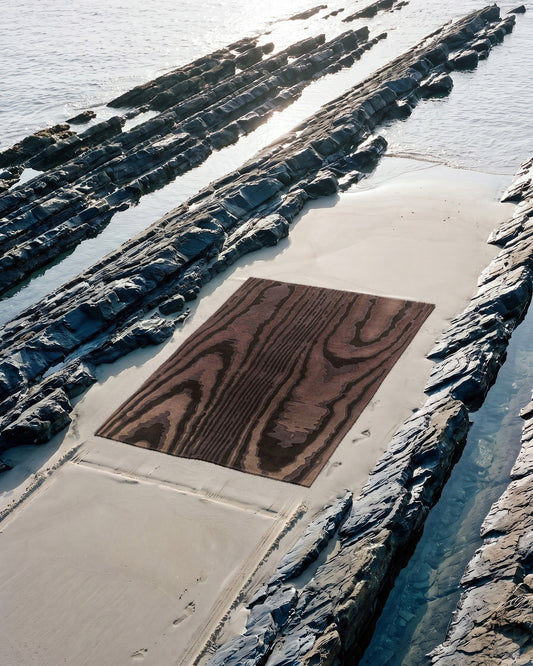
Take moiré. Moiré is, by nature, a phenomenon of superimposition, two slightly offset grids that create a third image, unstable, almost alive. It is beautiful because it is elusive. And it is elusive because it plays on very fine scales, micro-offsets, variations almost imperceptible to the eye.
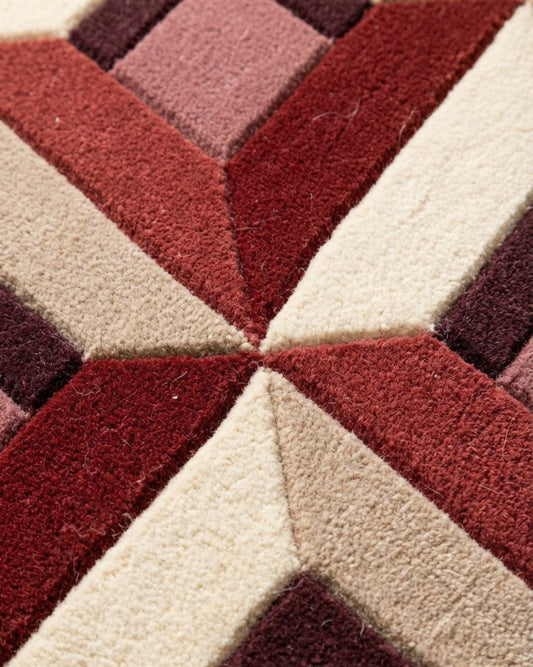
Handcrafted tufting, for its part, has its own laws. Every line made by hand has a cost. Details that are too tight make production time explode without a proportionate result. And wool, even the best New Zealand wool, does not have the rigor of the pixel. It lives, it flattens slightly, it absorbs light differently depending on the angle.
Making moiré in wool hand-tufted in Bhadohi is therefore a problem of translation: how do you recapture the vibration of an optical effect born of industrial precision, with a process that, by definition, breathes?
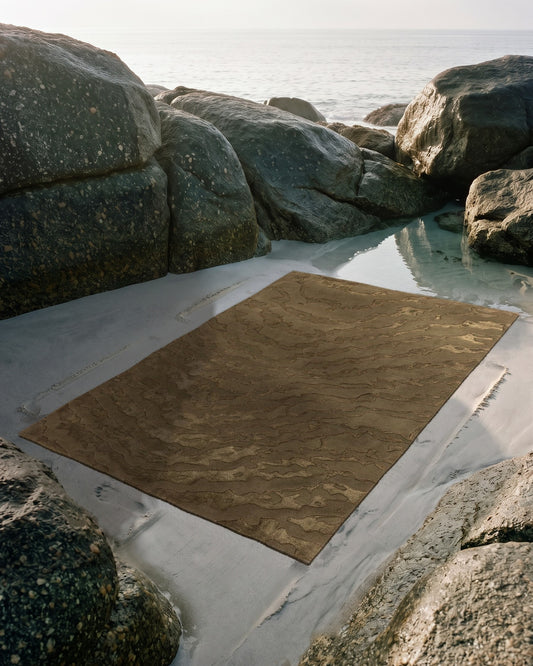
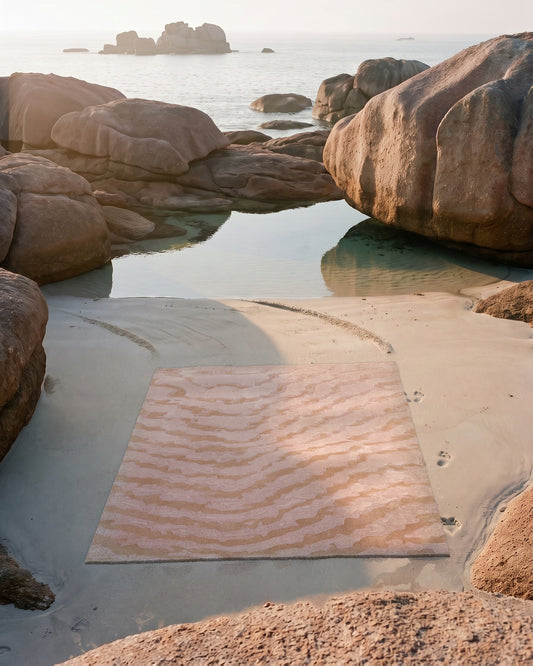
The answer does not lie in fidelity to the model. It lies in scale. Finding the dimension at which close colors, ochers, browns, very similar khaki greens, begin to pulse. Not so tight that the hand cannot follow them. Not so wide that the eye loses the tension. A balance that is tested, missed and started over.
Then there is the silk. On Frequency, only one of the three color areas is worked in silk; the other two remain in wool. This is not a choice made for prestige. It is an optical choice. Silk reflects light differently from wool: depending on the angle, the time of day, the light source, that area lights up while the others stay matte. Moiré, which was already a matter of perception, also becomes a matter of light. The rug changes. Not radically, but enough to keep you looking at it.
That is experimental design applied to the rug: not an aesthetic stance, not a stylistic exercise. A series of real constraints, technique, material, production cost, that we try to turn into an advantage. New Zealand wool is not a drawback when it comes to moiré. It is what gives the result its particular softness, its organic quality, the impression that the motif has grown in the fiber rather than been printed on it. And silk is not a veneer of luxury. It is a third dimension of the design.
A rug that poses no problem to design is rarely a rug that is interesting to look at.