Tufting and carving: what gives a rug its character
· 2 min read
At Rugier, every rug begins with a gesture repeated thousands of times, and ends with another, slower and more decisive.
Hand tufting, stitch by stitch
Tufting is a manufacturing technique in which wool is inserted by hand into a textile backing stretched on a frame, stitch after stitch, row after row. The artisan guides the needle by hand, adjusting the density, the pile height and the tension with each pass.
It is not a mechanized process. The regularity of a hand-tufted rug carries within it a slight irregularity, that of the human gesture. This is precisely what sets it apart from industrial production, and what gives it its density, to the eye and to the touch.
Our rugs are made in Bhadohi, India, in GoodWeave-certified workshops, by artisans whose expertise has been handed down for several generations. The material used is New Zealand wool, chosen for its resilience, its colorfastness and the quality of its feel.
Carving, or the art of sculpting wool
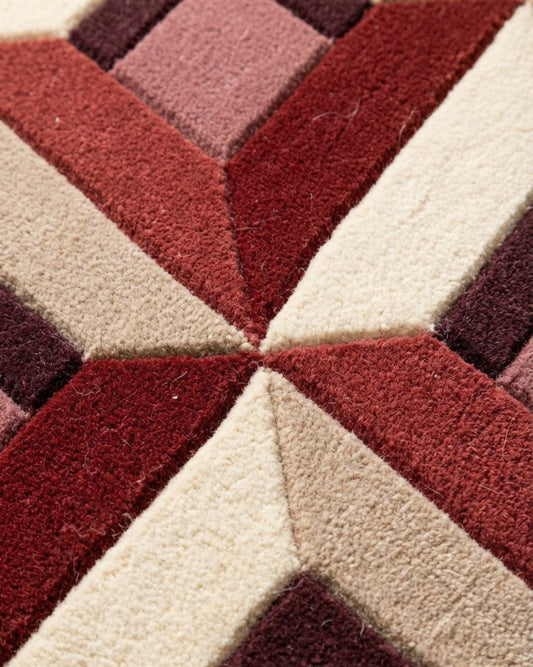
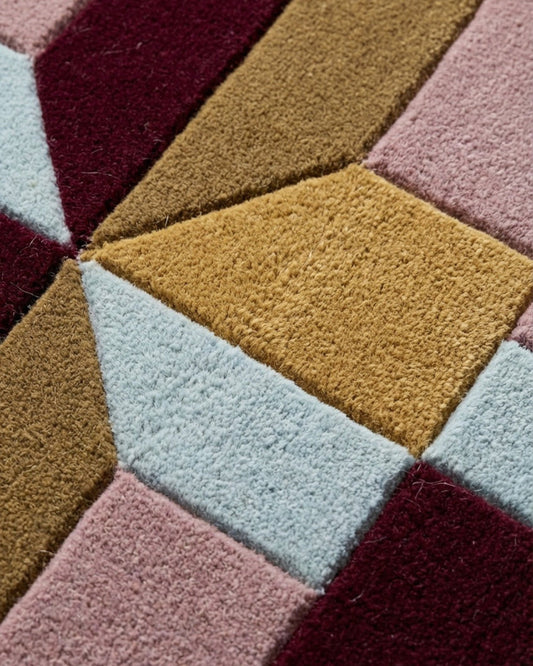
Once the tufting is finished, the rug passes into the hands of a sculptor. Carving consists of chiseling the wool along the contours of the motif with small curved shears, creating a slight difference in level between the areas of color or the geometric shapes.
The result is subtle but immediately perceptible: the lines gain precision, the shapes stand out from one another, the motif takes on an almost three-dimensional quality. The rug stops being flat. It has an inside.
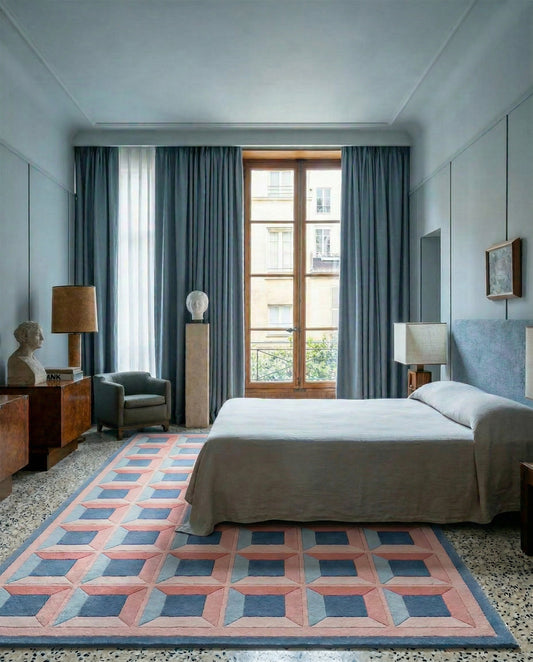
It is this stage that gives the Rugier collections their signature: crisp geometric shapes, contours that hold up under raking light, an object that looks different depending on the time of day.
Why these techniques, and not others
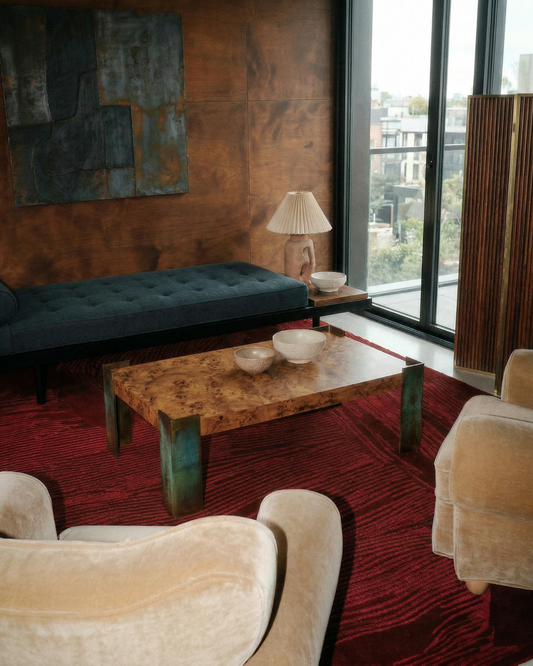
Tufting allows a freedom of design that traditional weaving does not easily allow. Patterns can be complex, flat areas of color wide, color transitions clear-cut. It is a technique particularly suited to strong graphic languages, to abstract geometries, to forms that were designed for the wall as much as for the floor.
Carving, for its part, is a constraint we have chosen. It slows down production, it requires a steady hand and a precise knowledge of the motif. But it is what makes a Rugier rug recognizable, even from a distance.