Hand tufting is a simple technique. That's why it's hard to do well.
· 2 min read
The tufting gun has nothing mysterious about it. It is a relatively recent tool, which appeared in the middle of the twentieth century, and it shoots wool through a cloth stretched on a frame. Compared with the hand-knotted rug, where each knot is made individually and can take months, even years of work, tufting is fast. Accessible. Democratized.
That is exactly what makes it a field where quality varies from one extreme to the other.
Because when a technique is simple to carry out, what sets the results apart no longer lies in the complexity of the gesture. It lies in everything surrounding the gesture: the quality of the wool, the density of the tufting, the precision of the design transferred onto the cloth, the care taken with shearing, the finishing of the edges. So many stages where you can speed up, substitute, approximate. And so many stages where it shows, or rather where it can be felt, underfoot, in raking light, after three years of use.
In Bhadohi, in Uttar Pradesh, the textile tradition goes back several centuries. This is not a marketing argument. It is a concrete reality: there is a concentration of expertise there, of transmission, of gestures learned from childhood, that cannot be improvised and is not easily relocated. The artisans who tuft our rugs do not just follow a design. They interpret it, in the musical sense of the word. A clean or approximate contour, an even or slightly irregular area of color, a relief sculpted with precision or in haste, all of this depends on a hand and an eye trained over the long term.
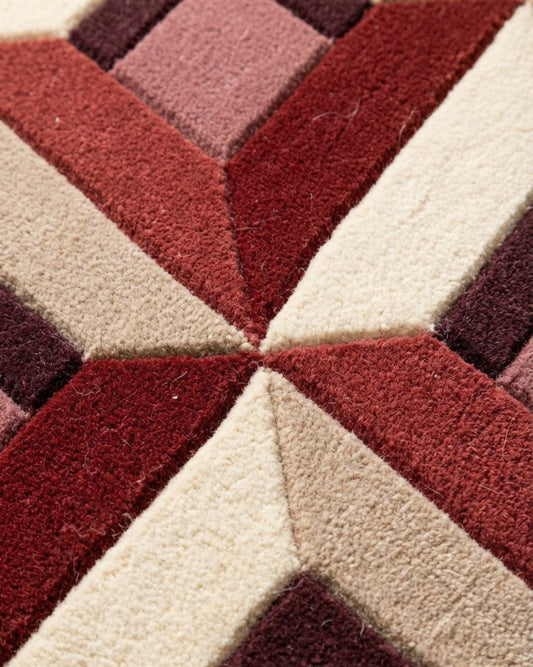
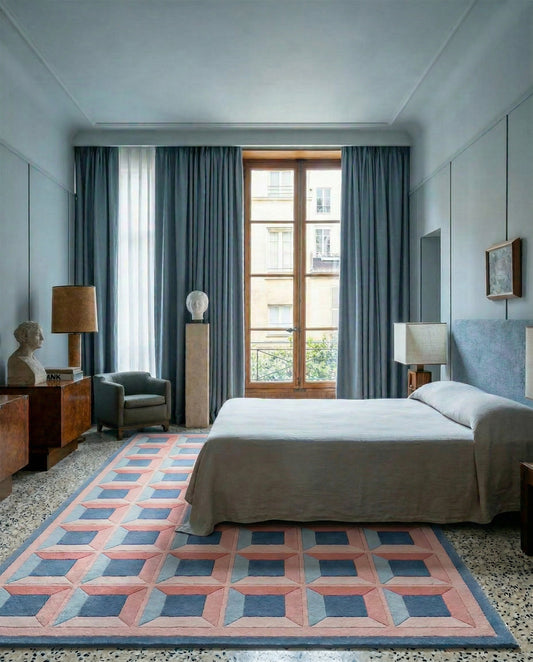
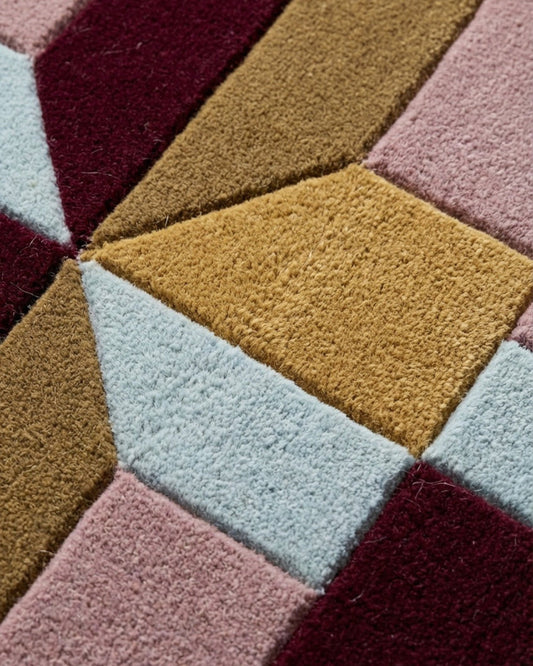
The design itself begins well before the workshop. It is scaled to the exact size of the rug and transferred onto the cloth with a precision that determines everything that follows. A blurred line produces a blurred motif. For rugs like Rugier's, where the pattern is graphically demanding, where areas of very similar colors must create a vibration without merging, this stage is not a formality.
Then comes the shearing. This is where the rug reveals or hides what it really is. A well-sheared surface is even and dense, with a pile lay that absorbs light uniformly. A poorly sheared surface has irregularities that the eye perceives without always identifying them. Carving, when the design calls for it, adds a further layer of difficulty: sculpting relief into the wool to accentuate a line, slightly hollowing out an area so that it recedes visually, cannot be improvised either.
What hand tufting allows, and what the knotted rug does not easily allow, is graphic freedom. Large flat areas of color, clear-cut geometries, optical effects that require precise contrasts at a precise scale, all of this translates better in tufting. That is why it is the technique we chose: not by default, not for reasons of cost, but because it is the one that best serves the kind of design we want to make.
A hand-knotted rug has its own qualities, its particular density, its extreme durability, its heritage value. But it imposes a different logic on the designer, more constrained, less suited to the contemporary graphic effects we are after.
Hand tufting done well is not a compromise. It is a choice.