Moiré effect. An enduring disturbance.
There are visual phenomena that we don't look for. We encounter them. On the fabric of a dress photographed too closely, on a poorly adjusted scanner screen, in the superimposed layers of a linen canvas. A slight misalignment, a frequency colliding with another, and suddenly something unexpected appears: an undulation, a depth, a movement in what was still.
This is the moiré effect. Not a drawn pattern, but a pattern that emerges. An interference between two regular grids, slightly offset from each other. Geometry then produces something it did not contain.
A physics of perturbation
Moiré is not an invention. It is an observation. Physicists know it as an interference phenomenon: when two periodic grids superimpose with a slightly different angle or frequency, their interaction generates a third grid, visible to the naked eye, which belongs to neither. The result depends on the angle, the spacing, the observer's movement.
What this implies is troubling: the pattern changes depending on where one stands. It is not fixed. It lives in the relationship between the surface and the gaze.
From textile to image
The word comes from fabric. Moiré originally referred to a wavy silk, worked by pressure to produce the changing reflections that made the fortune of 19th-century tailors. Napoleon III used it to wallpaper his apartments. Fashion houses made belts, linings, and ceremonial dresses from it. The effect was achieved mechanically, by passing the fabric between engraved cylinders, creating an irregular compression of the weave.
More recently, there was also an unintentional and famous use. In the 1990s, television cameras had an unfortunate tendency to mistreat moiré silk ties. When Jacques Chirac appeared on the small screen, his ties, always impeccable, often with tight patterns, sometimes produced psychedelic waves, parasitic rainbows, a chromatic vibration that their owner certainly had not chosen. This was the interference between the silk's weave and the analog camera's resolution. Moiré, in short, made a live appearance on TF1. All of France saw it without knowing what it was.
Then printers, photographers, and graphic designers adopted the word to describe the same phenomenon in their own disciplines: the visual artifact produced by two misaligned grids. Often undesirable in print, often exploited in art.
Bridget Riley made it a tool. Vasarely too. Op Art of the 1960s understood that moiré was not a defect but a resource: proof that the eye constructs what it sees, that perception is active, that the surface can lie with absolute rigor.
On the floor, another way of looking
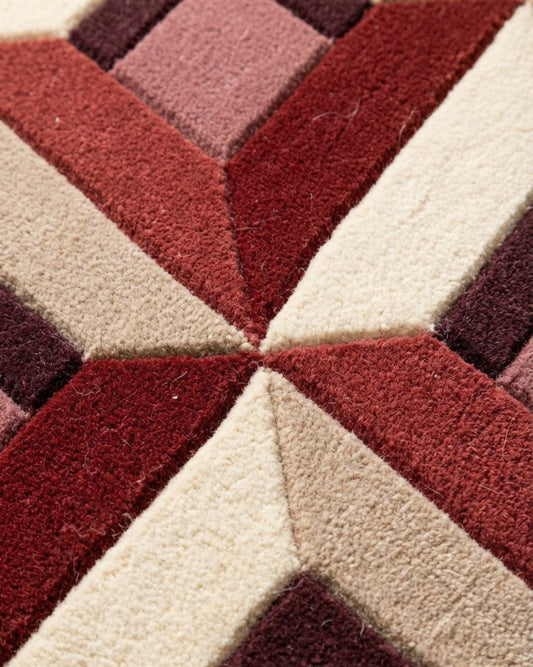
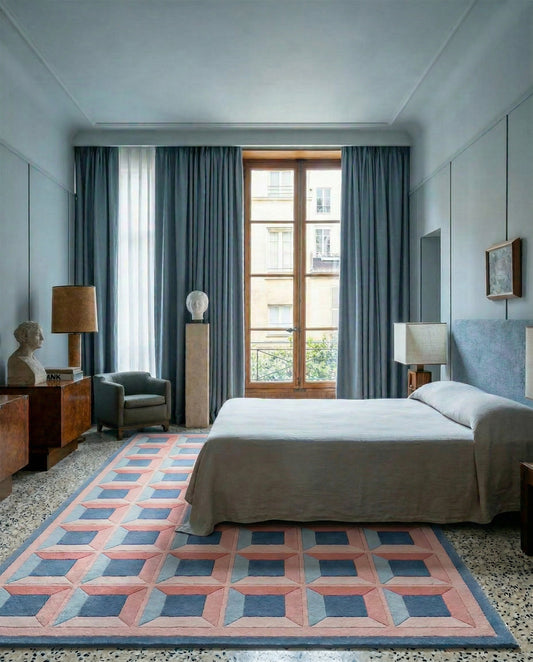
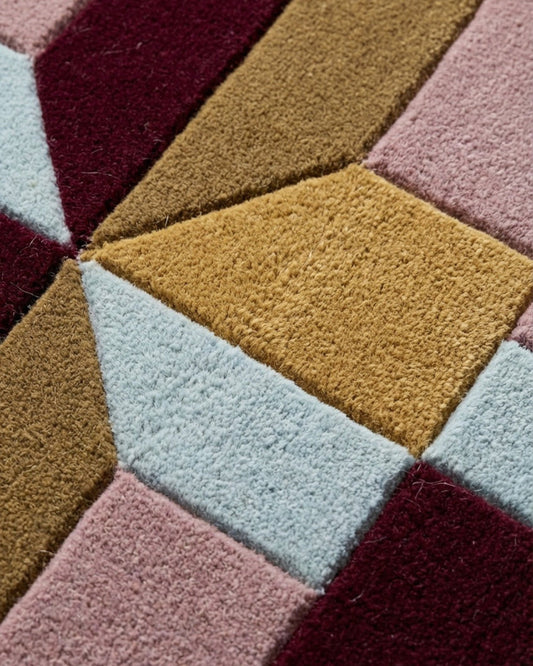
Rugier's Moirage collection starts from this idea: that tufted velvet, by its very nature, offers an ideal ground for interference. The rows of wool tufts, their height, their orientation, their density constitute a grid. When a geometric pattern is inscribed with a slight frequency shift, something happens that is not entirely predictable.
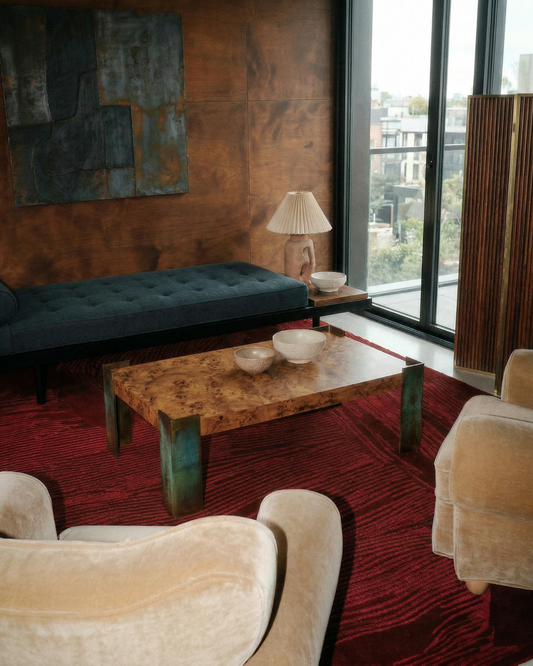
The rug moves. Not physically. Optically. You walk around it, and the waves shift. Natural light changes throughout the day, and with it, the legibility of the pattern. The rug seen from the door is not quite the same as from the window.
This is what we were looking for: an object that is not just placed in a room, but that enters into dialogue with it. That responds to light. That offers something different to those who pause and those who pass by.
New Zealand wool, with its natural luster, amplifies this effect. It captures and reflects light in a way that ordinary wool does not. The moiré is not printed on it. It is woven into the physics of the material.
A pattern with a story
There is nothing nostalgic about the Moirage collection. But there is a continuity. From silk taffeta pressed between cast iron cylinders to hand-twisted threads in a Bhadohi workshop, the same principle has spanned centuries: to provoke, from a strict rule, something unexpected.
The moiré effect is, at its core, a lesson on perception. It reminds us that what we see is never simply what is there. That the eye interprets, completes, invents. That the beauty of a surface can entirely reside in the gap between two frequencies. A rug with an idea.