Memphis saved me from beige.
At art school, I had a teacher who told me that Miami Vice was a trashy, kitsch reference. It was said with the tone of someone who thinks they are doing you a favor. The education I received there was part of a long tradition of functional minimalism, of purity as a cardinal virtue, of Bauhaus as an insurmountable horizon. Black type on a white background. Neutrality as the noblest aesthetic position.
I never believed it.
Not because I was rebellious on principle, but because I had references that seemed as legitimate as theirs, and infinitely more joyful. The 80s commercials I watched on repeat on YouTube. The interiors of Miami Vice with their palm trees and tropical geometries. And at the center of it all, a group of Milanese designers whose furniture made me smile the first time I saw it, and which I could never forget.
Memphis.
I then spent years trying to understand why these objects fascinated me so much. It wasn't nostalgia; I hadn't lived through the 80s, I was born too late. It was something else. An intuition that these assertive geometric forms, these colors that ask no permission, these combinations of printed laminate and real marble had something to say about how objects can exist in space. I ended up writing about it in Synthetic Nostalgia, a book about a generation's fascination with an era they didn't experience.
What I recount about Sottsass confirmed what I suspected. Memphis was not an aesthetic whim. It was the culmination of a lifetime spent questioning design, its contradictions, its complicity with industry and consumerism, its ability or inability to communicate something emotional and almost spiritual. Sottsass had navigated the rationalism of his architect father, the New York beat generation, the colorful markets of India, the radical anti-consumerism of the 70s. Memphis was the synthesis of all that: a rejection of neutrality as a value, a return of the object to its capacity for presence.
The Carlton shelf doesn't blend into an interior. It takes a stand. The Tahiti lamp doesn't complete an atmosphere; it creates one. These are objects that have something to say, and they say it without lowering their voice.
This is exactly the idea behind Rugier.
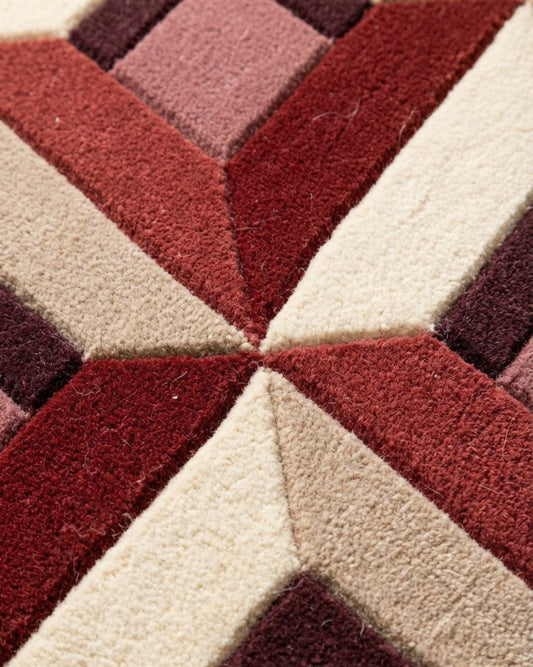
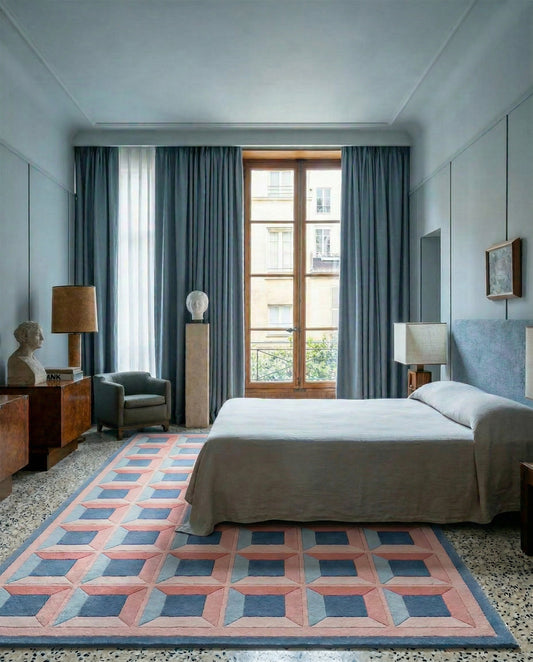
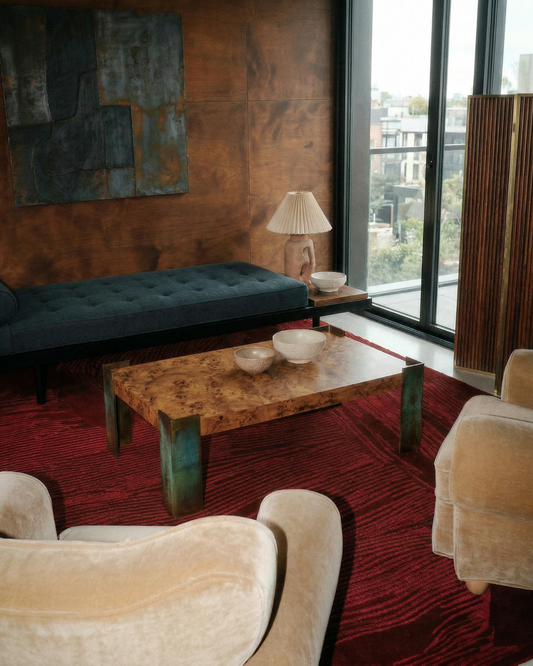
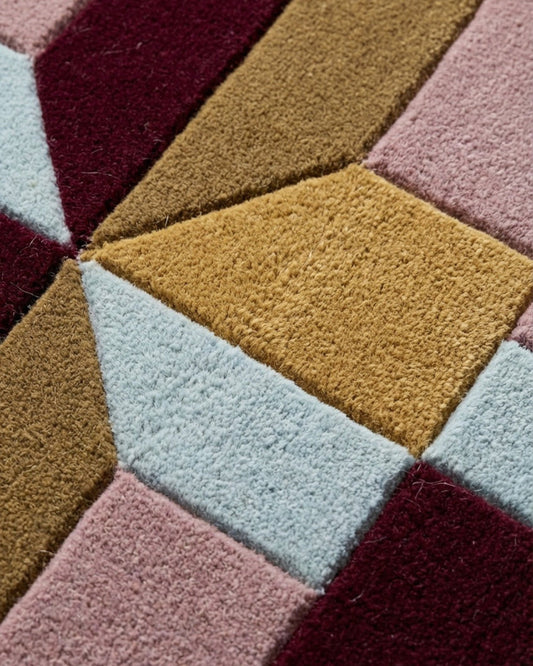
The rug is a special territory for this. Because it's on the floor, because it structures space without invading it, because it can be graphically radical while remaining functional, unlike a Memphis chair on which no one really sits. What I try to do with the Rugier collections is precisely that: designs that have a point of view, that don't try to please everyone, that play with optical effects and the constraints of artisanal technique to produce something yet unseen.
The return of postmodernism in interior design today doesn't surprise me. It responds to something real: the saturation of interiors that all look alike, the fatigue of consensual neutrality, the desire for the objects around us to have personality. What Sottsass understood in 1981 is that radicalism and rigor are not opposed. Memphis furniture is not chaos. It's precise geometries, calculated tensions, colors chosen to confront each other. Structure disguised as color.
Memphis was not an aesthetic whim. It was the culmination of a lifetime spent questioning design, its contradictions, its complicity with industry and consumerism, its ability or inability to communicate something emotional and almost spiritual.