Bridget Riley and Op Art: When Painting Affects the Body
· 2 min read
In 1965, the Museum of Modern Art in New York organized an exhibition titled The Responsive Eye. The title was a manifesto. The art on show did not seek to be looked at. It sought to act. On the retina, on the nervous system, on the viewer's physical perception. Visitors left disoriented, sometimes nauseous. Critics spoke of trickery, of cheap illusion. The artists, for their part, spoke of real perceptual phenomena, measurable and reproducible.
Bridget Riley was at the heart of this exhibition. Born in London in 1931, she began by copying Seurat, studied Divisionism, and analyzed how the juxtaposition of pure colors creates a vibration the eye cannot resolve. From this meticulous observation she drew a radical conclusion: if color and form can produce physical effects on the viewer, then painting is not a representation of the world. It is a direct intervention on perception.
Her first major works are in black and white. Movement in Squares in 1961, Current in 1964, Fall in 1963: grids, undulations, parallel lines that vary imperceptibly in thickness or spacing until they produce a sensation of movement, depth and vibration on a perfectly flat surface. It is not an illusion in the sense of a sleight of hand. It is the result of a precise understanding of how the eye processes visual information, of retinal persistence, of the way the brain tries to resolve tensions it cannot stabilize.
Victor Vasarely, a Hungarian based in Paris, had been exploring the same territory since the 1930s. His Zebra of 1938 is often cited as the founding work of Op Art: black and white lines that make figure and ground flip, that produce movement where no movement exists. But where Vasarely built quasi-mathematical systems, Riley worked in a more intuitive and more physical way. She did not seek to demonstrate. She sought to produce an experience.
From 1967 onward, she reintroduced color. Not to represent anything, but to exploit the interactions between adjacent hues. Bands of pure color, side by side, that create vibrations at their borders, that make colors appear that do not exist in the paint, that turn a static surface into something that pulsates. In 1968, she became the first woman to win the International Painting Prize at the Venice Biennale.
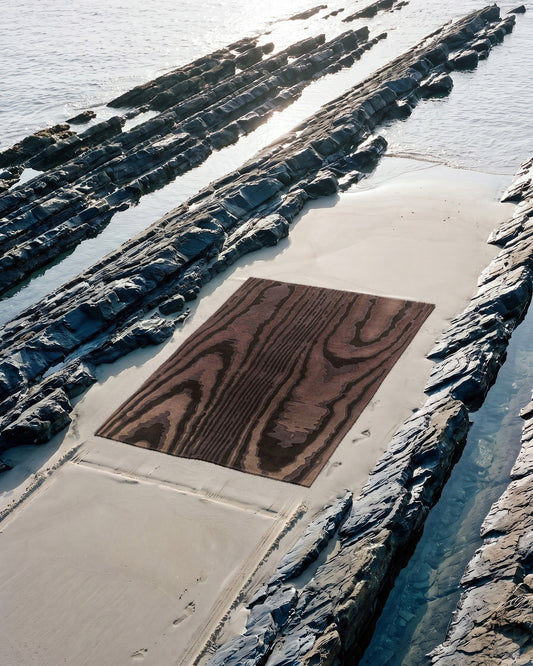
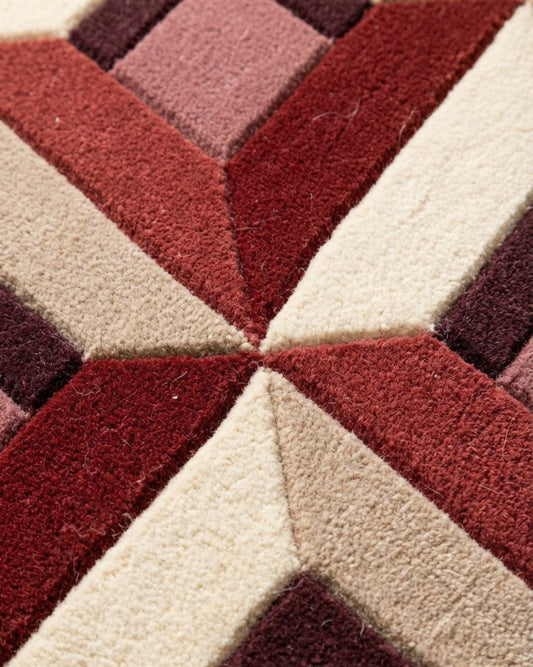
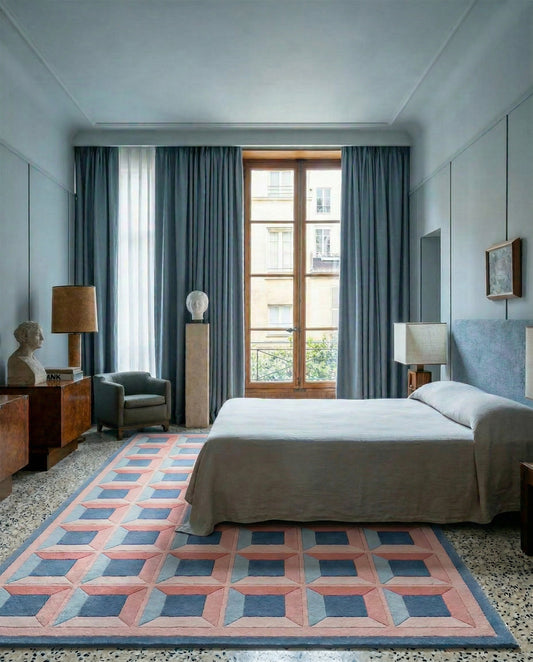
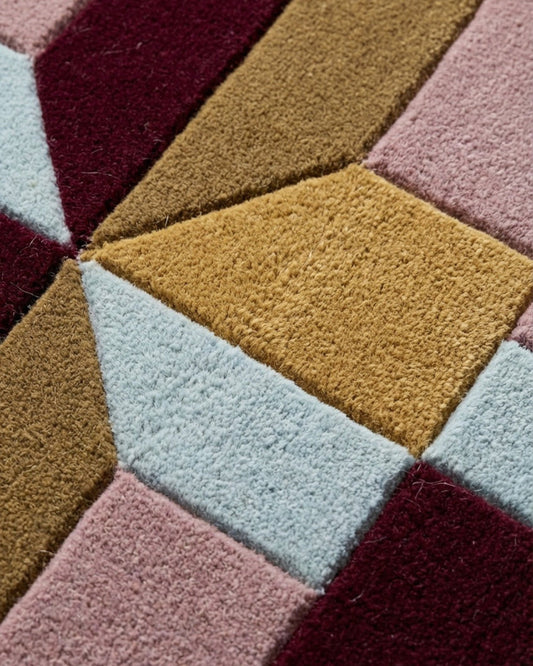
What makes this work particularly relevant to thinking about textile design is the question Riley has asked from the start: at what scale does an optical effect work? A vibration that operates on a 150 cm canvas does not necessarily operate on a 10 cm reproduction. The frequency of the lines, the gap between the hues, the size of the modules, everything has to be calibrated according to the viewing distance. This is precisely the challenge of translating an optical effect into a rug: the hand, the wool, the tufting stitch introduce a variability that painting does not have. What Riley mastered with pen and brush on stretched canvas has to be recaptured in an organic material, by hand, in a large format, designed to be seen from several distances at once.
The problem is the same. The solutions are different. That is where the work begins.