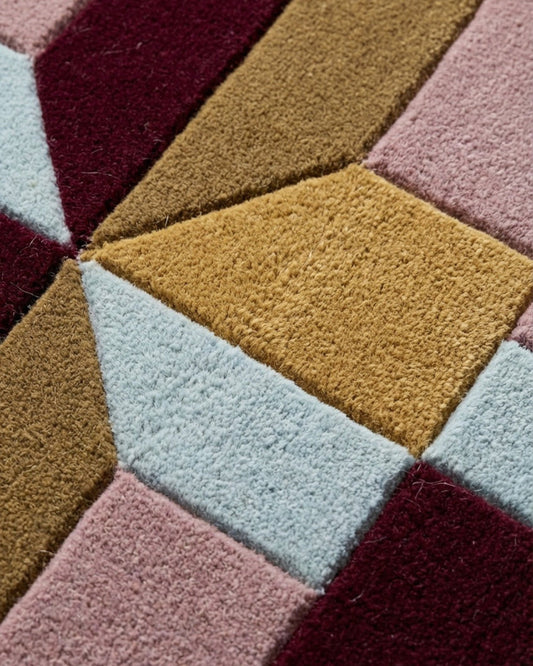
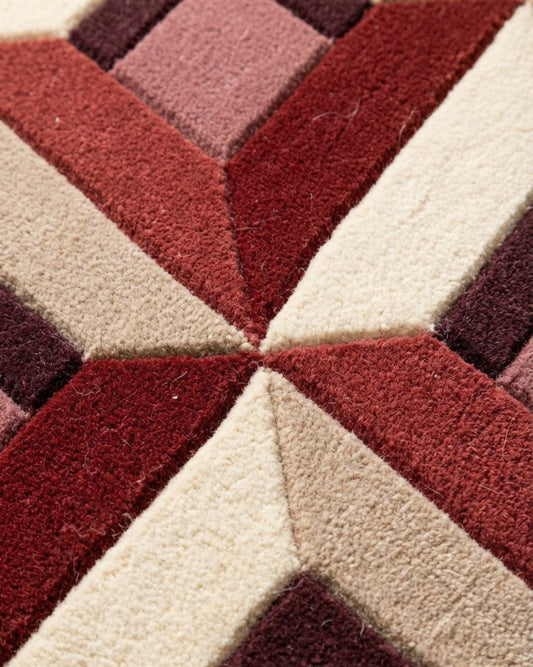
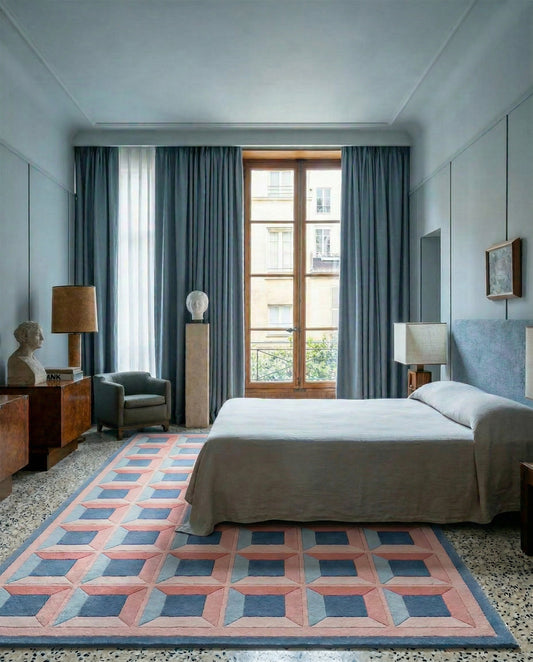
You do not ask yourself the question when you walk into the Ritz. You set down your bags, you look up at the ceiling, you notice the paneling, the flowers, the soft lighting. The floor is there, underfoot, obvious and invisible. And yet, if you pay attention, it is almost always geometric. Diamonds, Greek keys, trellises, motifs repeated endlessly over hundreds of square meters. Not a bouquet. Not a landscape. A grid.
This is no accident. It is a solution to several problems at once.
The problem of the crowd
A hotel is not a house. It is a space crossed constantly by dozens, sometimes hundreds of people who do not know each other, who do not have the same habits, who look in different directions. The floor has to work for everyone, simultaneously, without imposing a single reading.
A figurative motif poses a problem in this space: it creates a center, an orientation, a direction of reading. You enter the rug the way you enter a painting. But a hotel lobby is not a painting. It is a flow. People arrive from the street, head to the bar, come back from the elevator, wait near the front desk. Each person crosses the floor from a different angle.
Repeated geometry solves this elegantly. It has no center. It has no top or bottom. It works in every direction with the same active neutrality. It structures without directing.
The problem of wear
A palace hotel rug takes several thousand footsteps a day. At that frequency, any surface shows its wounds: the most walked-on areas fade, the colors flatten, the pile lies down in the direction of walking.
A geometric motif, especially when it is dense and multidirectional, disguises this uneven wear better than any other design. Variations in shade caused by foot traffic blend into the complexity of the motif. The eye reads the design, not the deterioration. It is a form of intelligence on the part of the floor.
The problem of silence
Grand hotels have an obsessive relationship with noise. Hard floors resonate, amplify heels, multiply conversations. The rug is there to absorb all of that, to create the particular acoustic quality that travelers associate with luxury without always being able to name it: relative silence, muffled sound, the feeling that the space breathes.
But a plain rug in a five-hundred-square-meter lobby is visually nonexistent. It disappears. A geometric motif gives the floor a visual presence proportional to its acoustic presence. It justifies the floor. It gives it a status in the room.
The problem of timelessness
A palace hotel cannot afford to look dated. It is rarely renovated, and never entirely. Rugs last ten, sometimes fifteen years. A motif too rooted in a fashion becomes a problem: it dates the space, it speaks of the era in which it was chosen rather than the era in which it is walked on.
Pure geometry escapes this risk better than any other decorative register. A diamond does not belong to the 1990s. A braid is not Art Deco. A grid is not contemporary. These forms have existed for as long as humans have woven, and they will go on existing. They predate taste. That is precisely why they outlive it.
What this says about the geometric rug in general
The lesson of palace hotels is not reserved for palace hotels. It applies to any space where the floor has to do serious work: respond to light, structure without constraining, age with dignity, exist without imposing itself.
A well-designed geometric rug is not a decoration. It is an architectural decision. It organizes space from the floor up, where everything begins, where the feet land before the gaze rises.
What grand hotels understood long ago is that the floor is not the background of the room. It is its foundation.