The most common mistake in a living room, the one you see everywhere and that is nonetheless costly to correct, is the rug that is too small. Not by much. Just enough for the sofa to float, for the coffee table to seem isolated, for the whole to give the impression of an unfinished interior. A rug that is too small does not go unnoticed. It draws the eye precisely because it lacks surface.
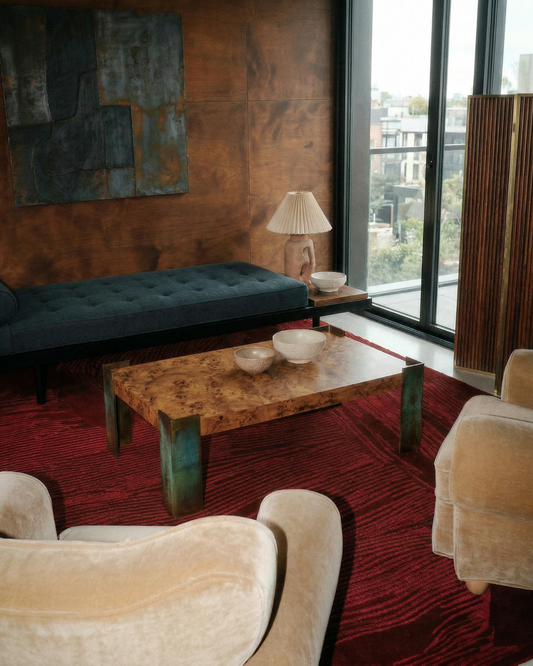
The basic rule is simple: the rug must create a territory. In a classic living room with a sofa, armchairs and a coffee table, it should go under the front legs of all the seating. Not under the coffee table alone, that is the trap of the "small decorative rug" that fragments the room instead of unifying it. Not under all of the furniture either, except in very large spaces. Front legs on the rug, the rest floating slightly above it: this is the configuration that gives the composition its visual stability.
In terms of actual dimensions, the guidelines are as follows. For a living room of 15 to 20 m², no less than 160 x 230 cm. For a living room of 20 to 30 m², 200 x 300 cm is the size that works best in the vast majority of cases. Beyond 35 m², you should consider 250 x 350 cm or more. When in doubt, go bigger. A rug that is slightly too large can be carried off. A rug that is too small has to be endured.
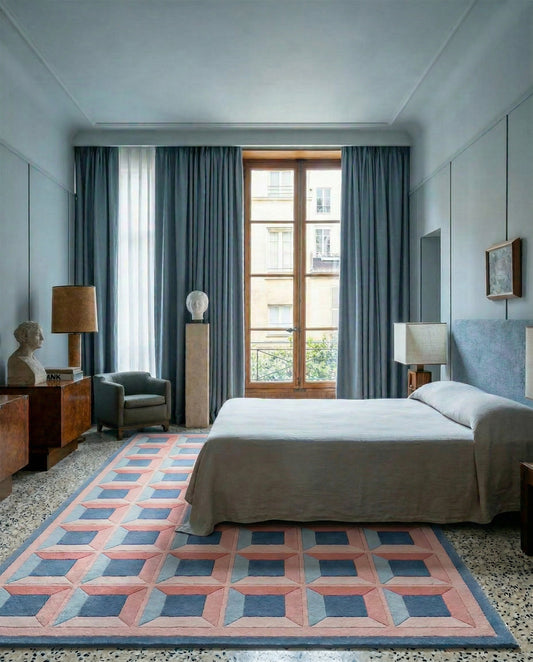
Another point that is often overlooked: the rug should not touch the walls. Leaving 20 to 40 cm of visible floor around it creates a frame, gives the room air and avoids the wall-to-wall look. In a Haussmann-era apartment with chevron parquet, this breathing space is also what allows the floor to go on existing around the rug, to play its own architectural role.
Widthwise, the rug should line up with the sofa or be slightly wider. If it is narrower, the whole arrangement tips over visually. The rug acts as a base: it must support what sits on it, not be forgotten underneath.
In an open living and dining space, the rug becomes a tool for marking boundaries. It defines the living area without partitioning it, structures circulation and gives each zone its own identity. This is particularly effective in large contemporary spaces where nothing else marks out the territories.
Size is technical. The rest is a matter of point of view.