The color of a rug doesn't make a room bigger. Contrast does.
· 1 min read
There is a decorating rule that gets repeated everywhere and that is wrong: light colors enlarge, dark colors shrink. It is a simplification that does more harm than good.
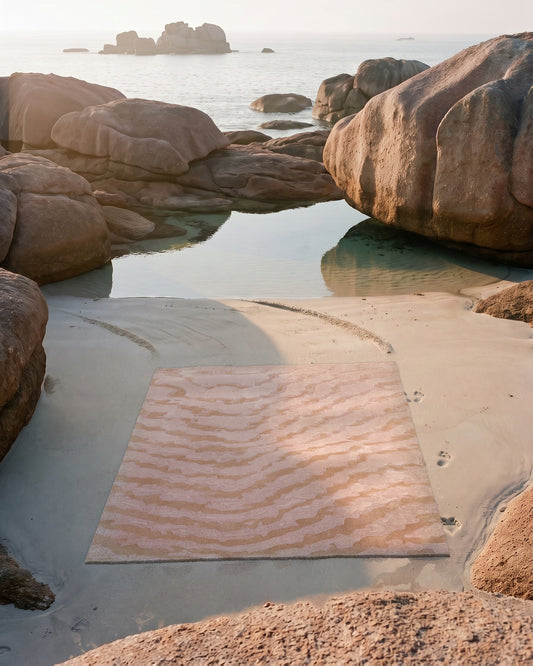
What the eye reads in a space is not color. It is contrast. A beige rug on blond parquet does not make the living room look bigger. It erases the boundary between the two surfaces and produces an undifferentiated space, with no territory, no anchoring. The room does not get bigger. It loses its legibility.
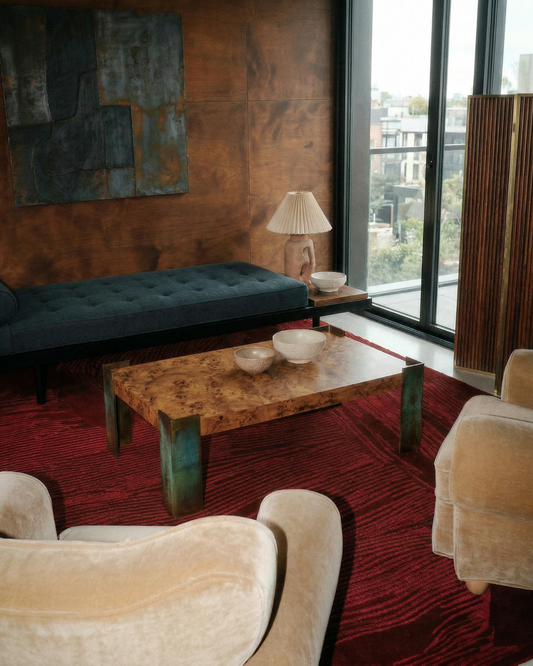
Conversely, a dark rug on light parquet creates a clear boundary. The living room exists. It has a center, a scale, a gravity. This clear-cut contrast can give a 25 m² room a presence that a light rug in a 40 m² apartment will never manage to produce.
Size plays the same role as contrast. A small rug, whatever its color, visually shrinks a space because it leaves the furniture floating with no shared territory. A generously sized rug unifies the volumes and gives the room immediate coherence. Proportion does more work than shade.
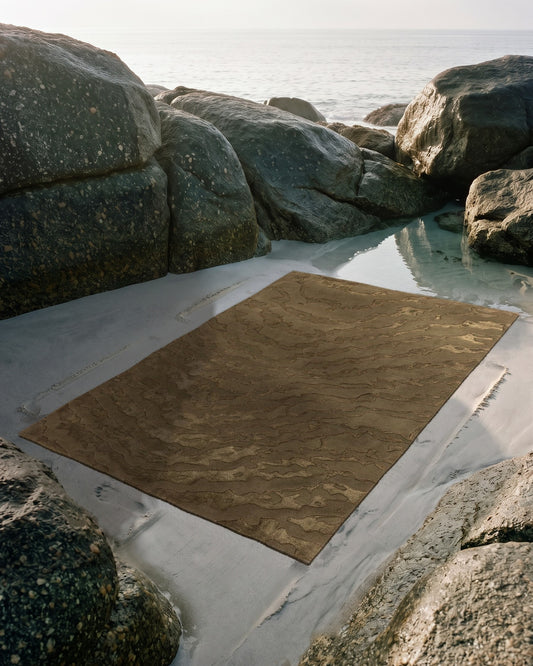
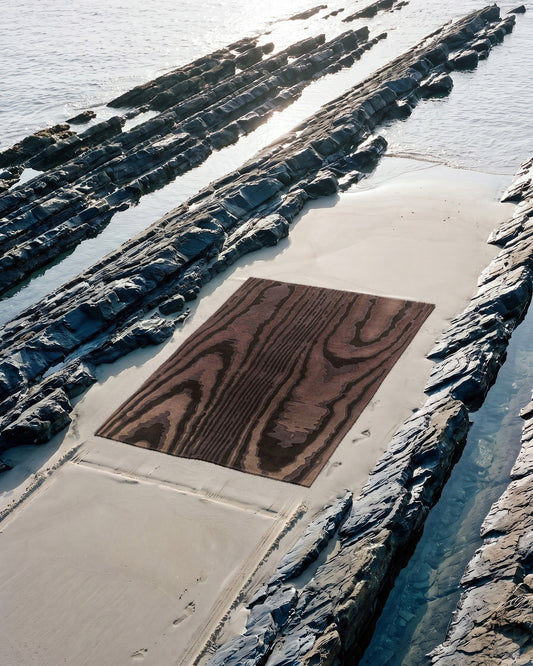
Texture complicates the equation further. Dense wool with shifting reflections catches and redistributes light in a way that a flat solid-color rug cannot reproduce. A dark rug in looped wool can look lighter than a light rug in matte synthetic fiber. Visual perception never comes down to a single variable.
Choosing the color of a rug by asking whether it will "enlarge" the room is asking the wrong question. The right question is: what role do I want this floor to play in the composition? Anchor, structure, brighten, assert. The color follows from that intention. Not the other way around.