A custom rug is born from an exchange between the person who designs it and the person who tufts it in Bhadohi, India. The artisan translates an intention into wool and silk, adjusts the colors against a physical color scale and sculpts the relief by hand. The result bears two signatures.
When a composition leaves the screen for a workshop in Bhadohi, it changes in nature. The drawing becomes a work instruction, read and interpreted by artisans who have handled wool for generations. Between the idea and the finished rug, a conversation opens up, made of shade cards, measurements and gestures. This dialogue, often invisible to the person who receives the piece, is nevertheless what sets a unique rug apart from an object reproduced identically.
Bhadohi, in Uttar Pradesh, is the main production hub for hand-knotted and hand-tufted rugs in India. The town and its region are home to thousands of workshops and to a knowledge passed down from father to son, structured today by quality standards and by GoodWeave certification, which guarantees the absence of child labor. This is where compositions imagined at a distance take shape, strand after strand.
From file to frame: what the artisan translates
A digital composition is a set of perfectly sharp shapes and flat areas of color. On the frame, these outlines must be transferred at full size onto a backing cloth, using a tracing known as the cartoon. The artisan enlarges the motif, checks its proportions and anticipates how each curve will behave once executed in wool yarns several millimeters thick.
This is when the first series of adjustments comes in. A very fine line on screen may need special treatment to remain legible in the material. An angle that is too sharp reads differently depending on the direction of the pile. The tufter does not alter the intention but makes it possible, taking into account constraints that only the workshop knows. This work of translation is already a form of interpretation, discreet but decisive.
The color scale: the screen does not tell the whole story
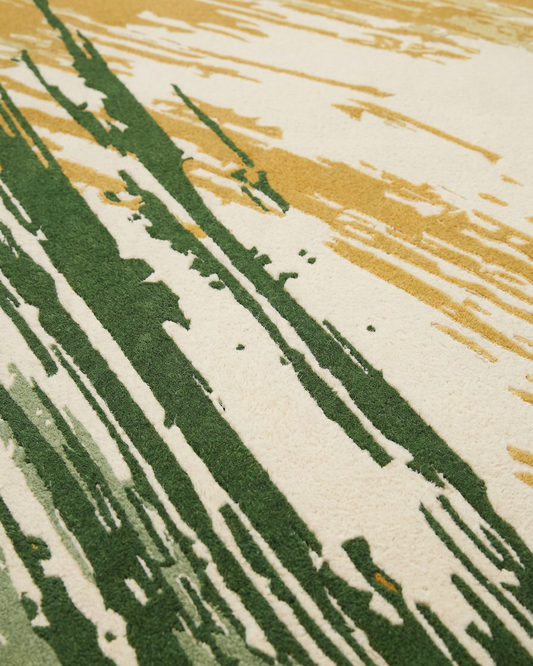
Color is the first ground for dialogue. A tone displayed on a screen is emitted light; the same tone, once dyed into wool, is reflected light, modulated by the texture of the fiber and by the orientation of the strands. New Zealand wool, known for its natural whiteness, absorbs dyes with an evenness that makes them easier to render, but the depth of a red or a blue is always judged on a real sample.
The workshops work from physical color scales, long shade cards of dyed wool that serve as a common language between the designer and the artisan. Choosing a shade means pointing to a precise yarn on this scale, then sometimes asking for a variation, a little warmer, a little more muted. Silk, used in touches, adds a sheen that catches the light differently from matte wool, and two fibers of the same nominal color can thus produce two distinct effects on the same rug.
A shade card of dyed wool is the true vocabulary of custom work: each strand on it is a word that the artisan and the designer use together.
Carving: sculpting relief into the material
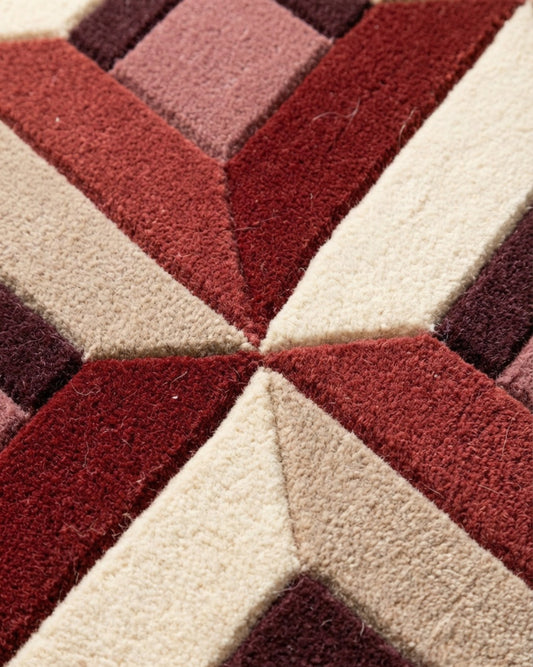
Carving, this technique of pile sculpting, shows clearly what the hand adds. Once the areas have been tufted, the artisan cuts the outlines with shears to hollow out grooves between the surfaces, creating a crisp relief that separates the motifs and plays with shadow. It is the work of a sculptor as much as of a rug maker, where the depth of the cut is decided by eye and by hand, with no machine to standardize the gesture.
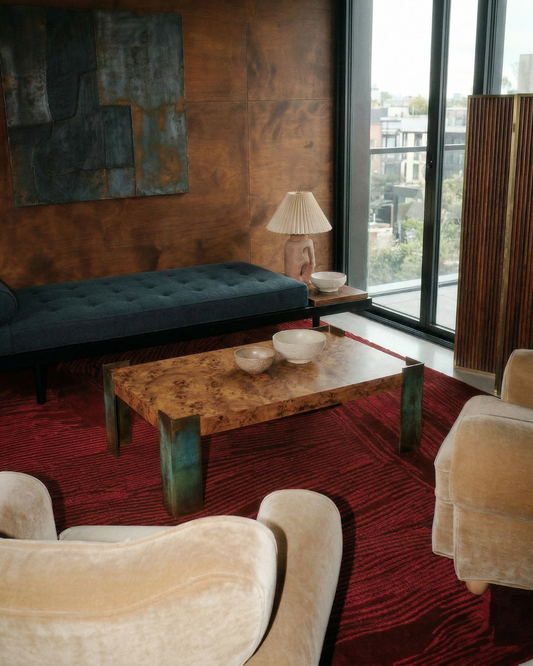
On relief collections such as La Pintura, this relief turns a flat motif into a living surface. Raking light reveals changes in level that the screen could only sketch. Here again, the artisan interprets, deciding the strength of a groove, the sharpness of an edge, the way two pile heights meet. These decisions, made in Bhadohi, become an integral part of the final design.
A co-signed object
A custom rug therefore bears the mark of two wills. That of the designer, who sets the shapes, the colors and the scale. That of the artisan, who makes the intention executable, adjusts what needs adjusting and inscribes in the material the irreducible trace of the manual gesture. No hand-tufted piece is perfectly identical to another, and this slight irregularity is not a flaw: it is the signature of the workshop.
Custom work takes on its full meaning when it is approached as this exchange rather than as a simple purchase order. Choosing a shape, testing a palette, imagining a relief height is already starting a sentence that the artisan will complete. Studio Rugier was designed to open this conversation: composing the shapes, colors and materials, then passing the intention on to the hands that will carry it out thousands of kilometers away.
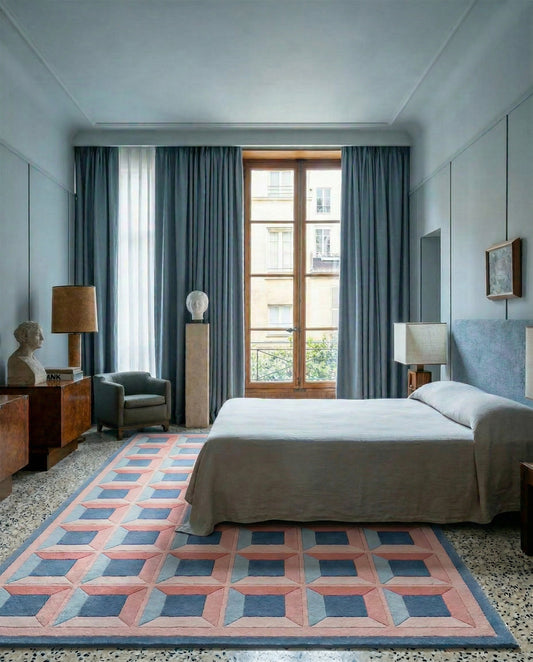
The rug that then arrives in an interior keeps this journey within it. It was conceived in one place, tufted in another, and discussed between the two. Looking at it means seeing two kinds of know-how overlap: that of composition and that of the hand. This is why a unique rug never belongs entirely to a single person.