New Zealand wool dominates the high-end tufted rug thanks to a rare combination: long, robust fibers, natural whiteness and great fineness. This whiteness allows for pure, luminous dyes, while the structure of the fiber guarantees strength and resilience over time. It is this balance that makes it a benchmark material for the workshops of Bhadohi.
In the world of the handmade rug, the choice of wool comes before everything else. Before the drawing, before the dyeing, before the tufter's gesture, there is a raw material whose qualities determine the final result. For several decades, New Zealand wool has established itself as the benchmark for workshops that make hand-tufted rugs, to the point of appearing as a mark of quality on the labels of the major houses. This reputation is not a matter of marketing: it rests on measurable properties of the fiber, shaped by a climate, a geography and particular sheep breeds.
A flock, a climate, a fiber
New Zealand mainly raises sheep of the Romney, Coopworth and Perendale breeds, selected not for the fine wool used in clothing, but for a so-called crossbred wool, thicker and longer. This is precisely what the rug industry is looking for. The temperate, humid climates of the archipelago, its abundant pastures and the practice of extensive farming produce an even fleece, clean and low in vegetable matter.
The country has also developed a rigorous sorting and grading system. Fleeces are classified by fineness, length and color, which allows spinning mills to put together homogeneous lots. For a tufting workshop, this consistency is decisive: it guarantees that the wool received from one order to the next will behave the same way under the needle and in the dye bath.
Fiber length, the foundation of strength
Crossbred New Zealand wool stands out for its considerable fiber length, often well above that of apparel wools. This length has direct consequences for the yarn. A yarn made of long fibers has fewer loose ends on the surface: it pills less, wears more slowly and keeps its appearance longer under repeated foot traffic.
In a tufted rug, strands of wool are inserted in loops through a backing cloth using a tufting gun. These loops are then cut to form the pile, or left as they are. The strength of each strand determines how well the pile holds up: a long, resilient fiber better withstands the twist of the yarn, the pulling force of tufting and the daily compression of footsteps. This is what distinguishes a rug that keeps its density from one that sags and thins out.
Whiteness, the condition for true color
The most visible characteristic of New Zealand wool is its natural whiteness. Many wools have cream, yellowish or grayish tints that interfere with dyeing. New Zealand wool, by contrast, offers a particularly light and even base, with few stray pigmented fibers.
This whiteness acts like a blank canvas. On a light base, dyes reveal their full purity: bright shades stay vivid, pastels do not shift, and subtle nuances remain distinct from one another. For a house that works with demanding palettes, whether a radiant yellow, a powder pink or a deep blue, this color fidelity is decisive. The same color applied to a yellower wool would give a dull or off-tone result.
A color is only as good as the ground it rests on: the whiteness of the fiber is the first guarantee of a faithful shade.
Deep, lasting dye uptake
Beyond its starting color, wool has an internal structure that makes it particularly receptive to dyes. The fiber is made of keratin, whose chemical bonds firmly fix the dye molecules. New Zealand wool, through the regularity of its diameter and the openness of its scales, absorbs dye baths evenly and deeply.
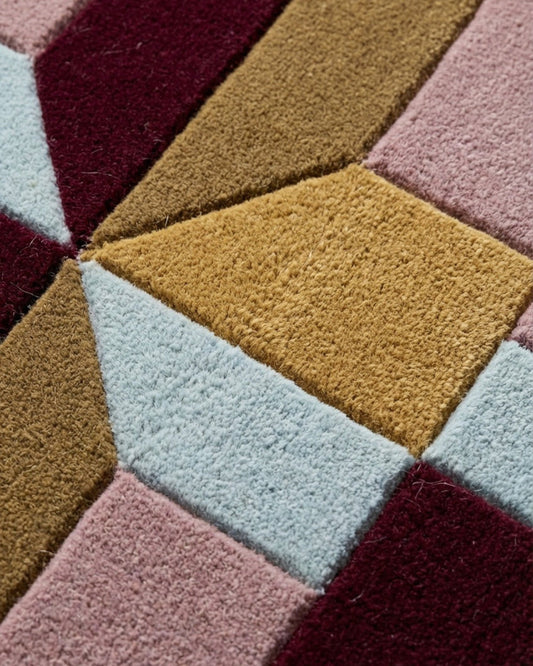
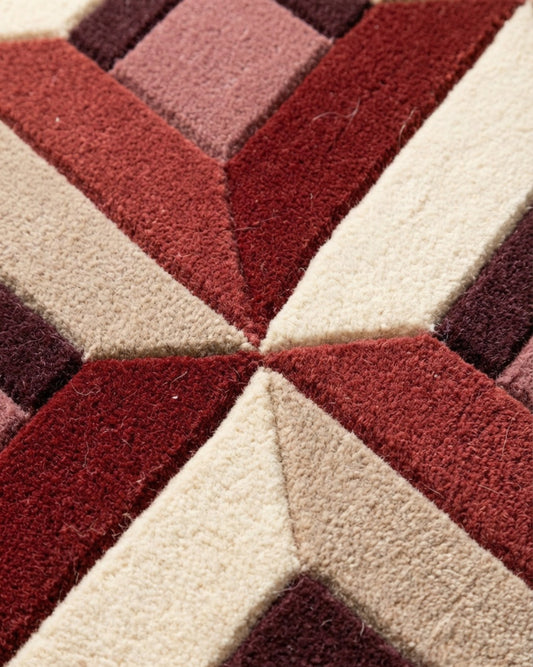
In practical terms, this means a color that penetrates to the core of the strand rather than staying on the surface. The rug resists fading in light better, and wear on the pile does not reveal a paler fiber core. This deep dyeing is what allows collections with strong contrasts, whether geometric patterns or sculpted reliefs, to keep their graphic legibility after years of use.
What the fiber brings to the hand-tufted rug
All these properties converge on the same result: a dense, colorful and durable rug. The natural elasticity of wool allows it to regain its shape after compression, so that the marks left by footsteps and furniture fade. Its ability to trap air gives it appreciable thermal and acoustic insulation. And its natural ability to repel liquid spills, thanks to the thin waxy layer (lanolin) that remains on the fiber, makes it a surprisingly practical material.
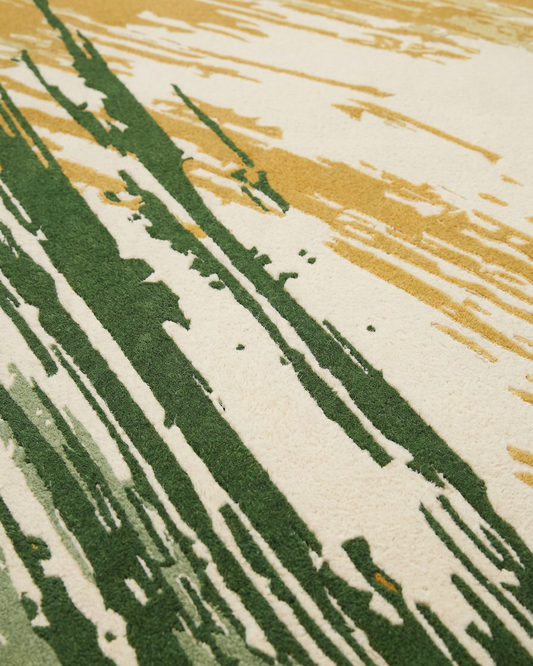
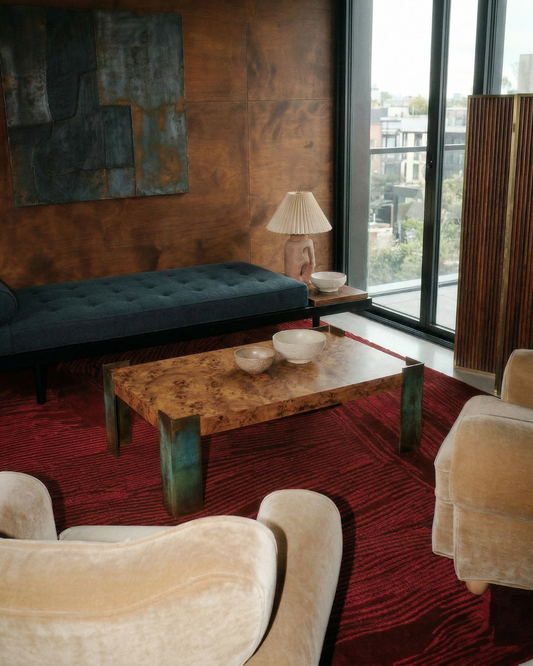
At Rugier, this wool is paired with silk for certain details, in rugs hand-tufted in Bhadohi and certified by GoodWeave. Silk brings sheen and fineness of line; New Zealand wool provides body, depth of color and longevity. For the sculpted reliefs of La Pintura as for the saturated flat colors of Optical Palazzo, it is the same demand on the material that governs the result.
Understanding why this wool serves as a benchmark means grasping that a rug is not just a drawing laid on a floor. It is an object whose durability, color and comfort are determined first of all in the fiber. The choice of New Zealand wool is anything but incidental: it shapes the quality of everything that follows.