Silk is a very fine, smooth fiber that reflects light directionally: its color changes with the viewing angle and the orientation of the strands. In a tufted rug, it does not replace wool; it enhances it by drawing brighter areas that catch raking light. Strong under tension but sensitive to abrasion and moisture, it is reserved for accents rather than for large flat areas exposed to foot traffic.
Silk holds a special place among textile fibers. Produced by the caterpillar of the mulberry silk moth, it unwinds into a continuous filament that can reach several hundred meters for a single cocoon. This continuity, rare among natural fibers, explains some of its properties: where wool is made of short fibers held together by twisting, silk forms a smooth, regular thread whose surface reflects light instead of diffusing it.
Understanding what silk brings to a tufted rug means looking first at the fiber itself, then at the way it behaves once set into a wool ground. The two materials do not play the same role, and it is precisely their difference that creates visual interest.
Why silk shines: the geometry of the fiber
The silk strand has a triangular cross-section with rounded corners, a little like a prism. When light strikes it, it is reflected directionally: part of it goes back toward the eye, another part continues on its way. This is called specular reflection, as opposed to the diffuse reflection of a matte surface. The consequence is immediately visible: the same area of silk looks light from one angle and darker from another.
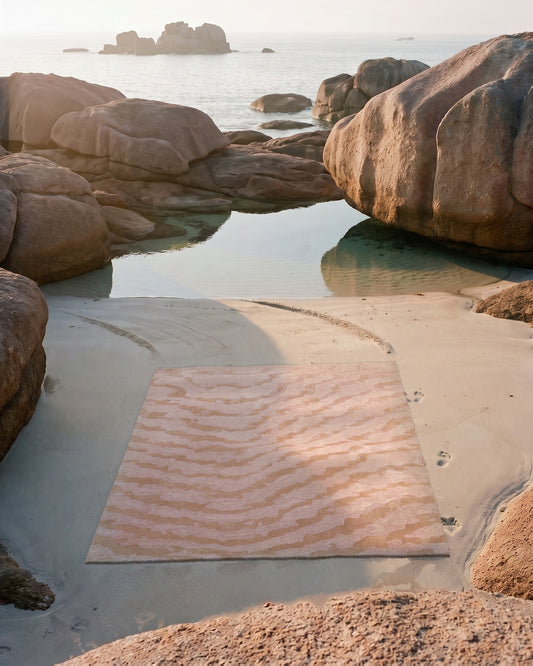
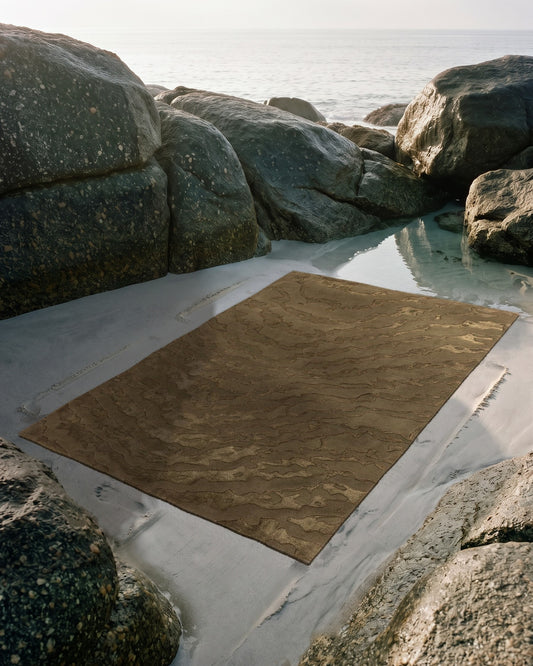
This behavior echoes the one we describe in relation to the ripple that seems to move with your gaze. In a rug, the orientation of the strands counts as much as their color. Two areas tufted with the same yarn, but lying in opposite directions, will read as two distinct shades. This is not a flaw; it is the very principle of the play of light.
The fineness of the fiber accentuates the phenomenon. A strand of silk is markedly thinner than a strand of wool, which allows a high stitch density and a crisp rendering of contours. Where wool rounds off lines, silk sharpens them. It therefore also serves to draw: a fine outline, a rib, the boundary between two fields of color.
Silk and wool: two complementary materials
Wool remains the base material of the tufted rug, and for good reasons. Elastic, resistant to crushing and naturally insulating, it provides comfort and longevity, as our article on the wool rug, an acoustic and thermal regulator points out. Rugier works with New Zealand wool, known for its whiteness and consistency, which takes color well.
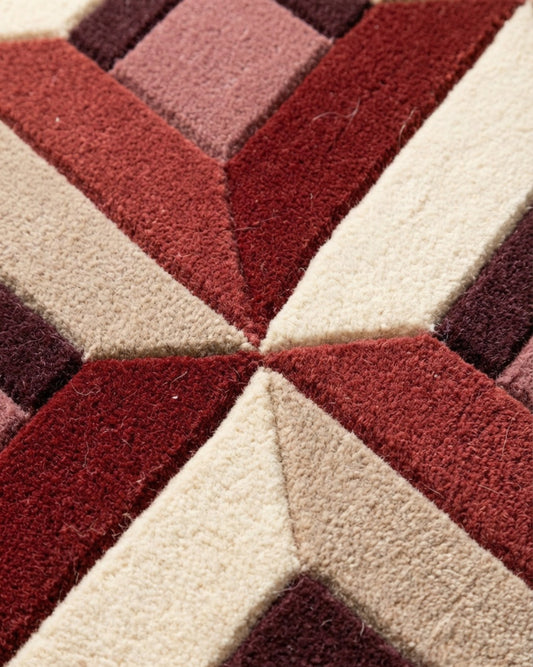
Silk comes in as a counterpoint. Its smooth surface and its sheen create a contrast in texture with wool, which is more matte and denser. On the same rug, the eye immediately distinguishes the silk areas, not by their color but by the way they catch the light. This difference in material gives relief to a design without any need to sculpt the surface.
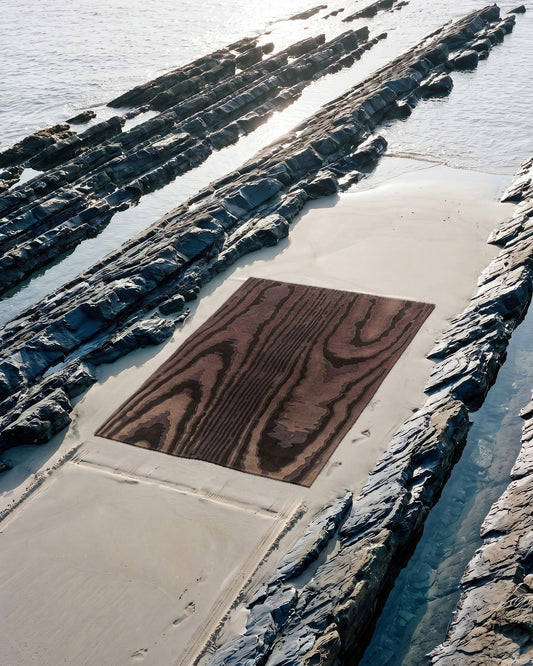
This combination structures the Moire collection, where the effects of sheen follow the undulations of the pattern. On a design like Agata, silk highlights the passages where light should seem to glide, while wool holds the grounds. The balance between the two is decided design by design.
Strength and use: where to place silk
Silk has remarkable tensile strength for its weight: at equal diameter, it rivals technical fibers. But this strength should not be misleading about how it behaves on the floor. The fiber withstands repeated abrasion and heavy foot traffic less well than wool, and it is more sensitive to moisture, which can alter its sheen and its colors.
These characteristics dictate a simple rule: silk is reserved for accents and less exposed areas, while wool covers the traffic surfaces. A rug made entirely of silk belongs to another use, often more decorative than functional. In a mixed rug, it brings brilliance where it counts, without bearing the mechanical stress on its own.
Care follows the same logic. Silk calls for measured gestures, careful drying and particular vigilance with stains, points we detail in our guide to caring for a wool and silk rug through the seasons. A well-designed rug places silk where it will last a long time.
Composing with silk: light and placement
Since silk changes appearance with the angle, its rendering depends closely on the light in the room and the position of the rug. The same area will shine under a window at the end of the day and look more subdued at noon. This sensitivity is worth anticipating, as we explain in our article on how to match a custom rug to the light of a room.
In practice, it is worth observing where the dominant light comes from before deciding where to concentrate the silk. Placed facing a raking source, it reveals its full brilliance. Lost in an area of permanent shadow, it loses some of its interest. This thinking is part of the work carried out in Studio Rugier to compose a custom rug, where the choice of materials is considered at the same time as that of colors and design.
Still, silk is a tool, not an end in itself. Used with restraint, in dialogue with wool and the gesture of hand tufting as practiced in Bhadohi, it gives the rug a depth that the eye discovers as it moves. It is this changing reading, more than the sheen itself, that justifies its presence.