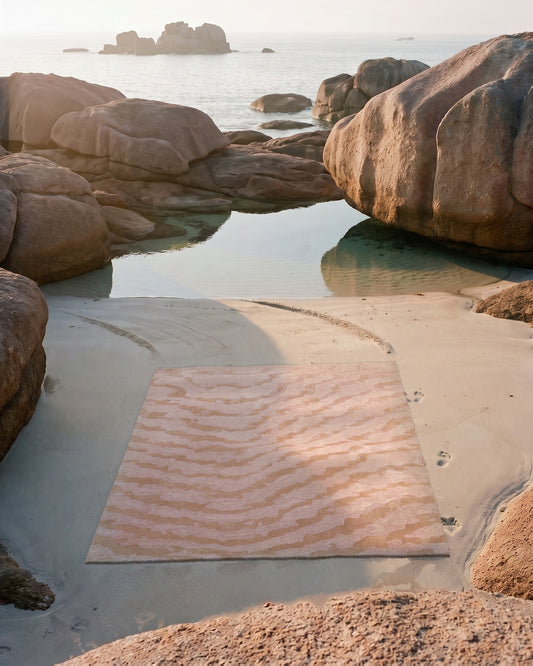
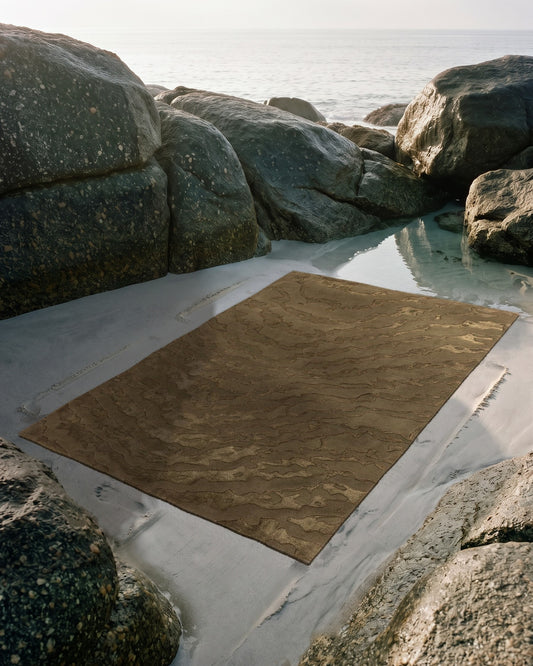
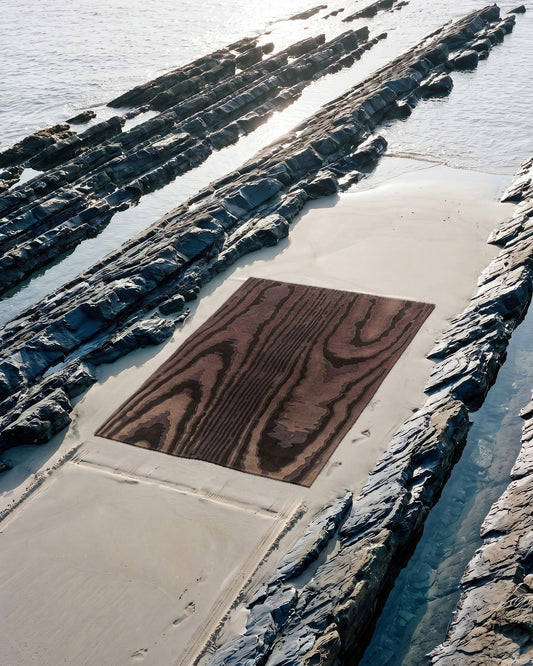
Moiré is an optical effect produced by overlaying two regular grids that are slightly offset: their interference creates ripples that seem to move with the viewer's gaze. In textiles, it appears on silk pressed between two engraved rollers. A rug can recreate it through the play of pile heights and the orientation of the fibers.
What produces this ripple?
Moiré is a phenomenon of visual interference. When two regular grids, two series of lines or dots, overlap with a slight offset in angle or spacing, the eye no longer perceives the two grids separately but a third pattern, larger and sinuous, that exists in neither of them. This pattern is the moiré. It changes shape and position as soon as you move, because the offset between the two grids varies with the angle from which you look at them.
It can easily be observed in everyday life: two sheer curtains hung one in front of the other, the railing of a balcony filmed by a camera, two window screens placed against each other. Wherever two fine, periodic structures meet, interference produces these light and dark bands that ripple. The brain, used to reading regularities, interprets this beating of frequencies as a moving relief.
The geometry of the phenomenon is precise. The smaller the angle between the two grids, the wider and more widely spaced the moiré ripples. Increase this angle and the pattern tightens. This mathematical relationship also has technical uses: optical metrology relies on moiré to measure tiny deformations of a surface, because the slightest discrepancy between two grids becomes visible on a large scale.
From accident to ornament: moiré in silk
The word comes from the English mohair, itself derived from Arabic, before making its way back into French as “moire.” Originally, it referred to a fabric whose surface showed wavy reflections, obtained by a mechanical treatment of the cloth. The technique developed on silks from the 17th century onward, notably in French and English manufactories devoted to ceremonial fabrics.
The traditional process, calendering, consists of folding the fabric over on itself, then passing it under heavy heated rollers that crush the weave irregularly. Threads flattened in one direction reflect light differently from those left raised. This play of crushing creates two surface orientations which, by interfering, draw the famous waves. On silk, whose long, smooth fibers reflect light brilliantly, the effect reaches a particular depth.
Moiré thus became a sign of refinement in the clothing and furnishings of the 18th and 19th centuries. It was used for court gowns, wall hangings, seat coverings and bookbindings. Moire carried an idea of discreet splendor: a plain material which, instead of a printed decoration, offered a movement born of its structure alone. Honorary decorations have kept this moiré ribbon, a symbol of a distinction that the fabric carries in its very texture.
Moiré places no design on the fabric: it brings a pattern out of the meeting between material and light.
A kinship with 20th-century optical art
What old silk-making obtained by mechanical chance, 20th-century artists explored systematically. Op Art, in the 1960s, made the interference of grids a language in its own right. Bridget Riley, with her networks of undulating black and white lines, and Victor Vasarely, with his distorted grids, gave the viewer the same sensation of vibration and movement that textile moiré already produced, on a smaller scale, in the folds of a dress.
The lineage is direct: in both cases, a regular structure is set in tension with itself so that the eye produces movement where the surface is still. Moiré belongs to this family of phenomena in which perception adds something that the material does not literally contain. Understanding moiré means understanding part of the way Op Art works on the retina.
Translating moiré into a hand-tufted rug
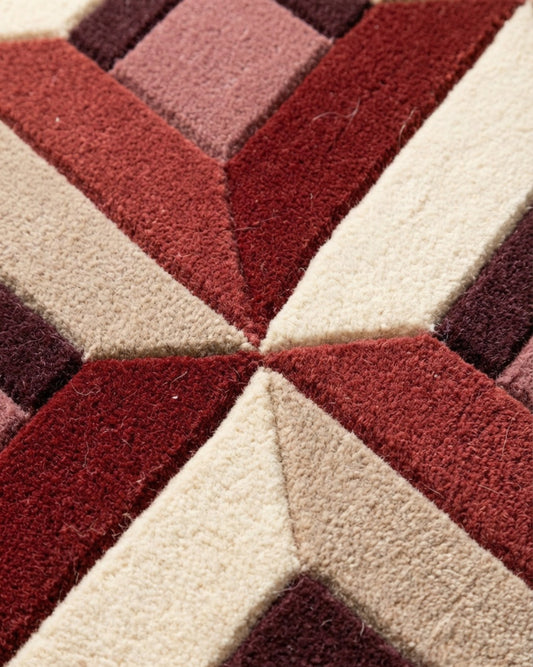
A rug is not pressed silk, but it has its own language for recreating the moiré ripple. Tufted pile is made of thousands of strands of wool standing side by side. Their orientation, the way they lie, determines how light bounces off their surface. A strand lying toward the viewer looks light; the same strand lying the other way looks dark. This is the principle of pile shading, long known to upholsterers.
By modulating the orientation of the fibers, the pile height and sometimes two qualities of yarn, New Zealand wool for the body and silk for the luminous accents, the artisan can compose areas that reflect light to different degrees. Arranged in regular, slightly offset grids, these areas give rise on the surface of the rug to the characteristic beating of moiré. The pattern then shifts with the position of the viewer and the time of day, exactly as on the old fabric.
Hand tufting, as practiced in Bhadohi, lends itself well to this work because it allows fine control of each area of pile. Carving, this relief cutting of the pile, can further accentuate the boundaries between the grids and give the ripple a physicality that flat silk did not have. Moiré stops being a surface reflection and becomes a discreet topography, perceived first by the eye, then by the hand.