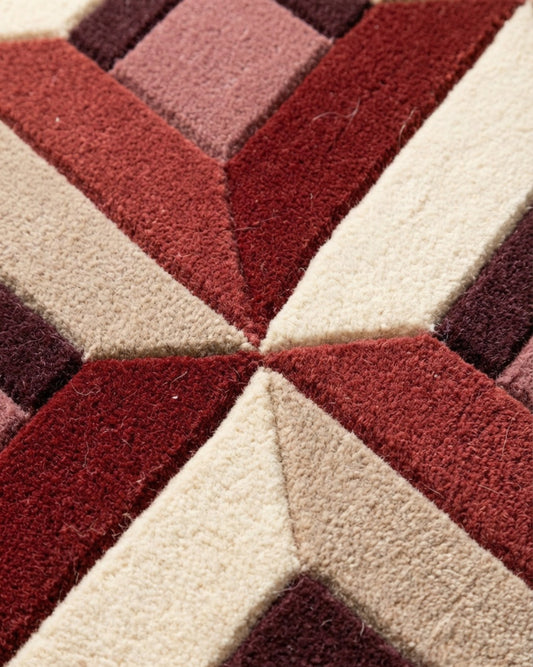
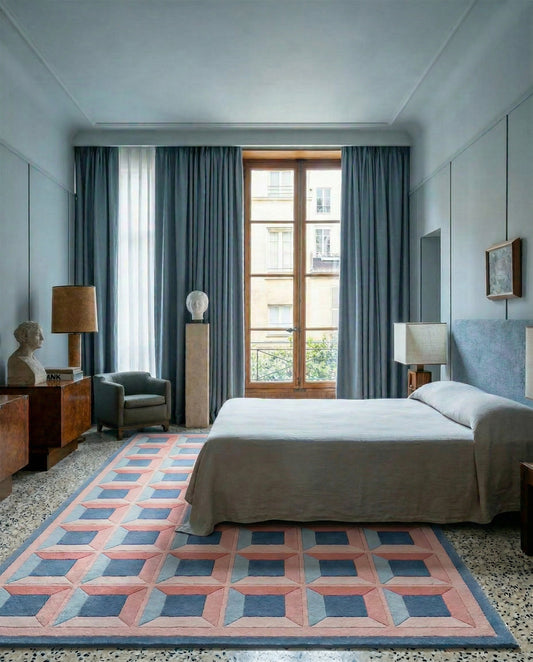
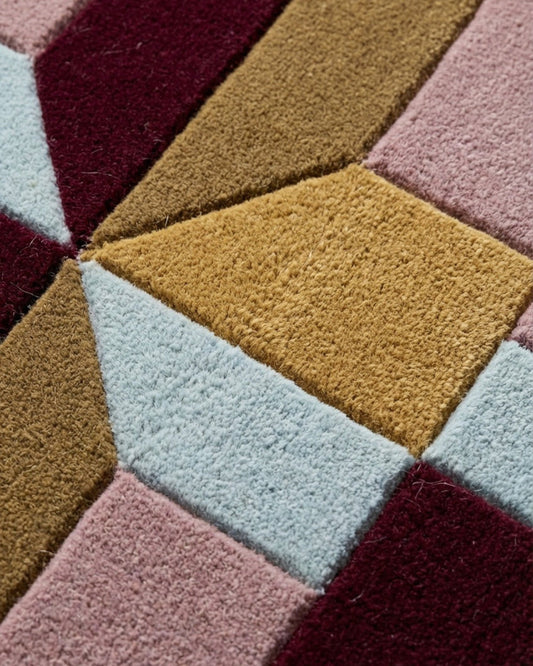
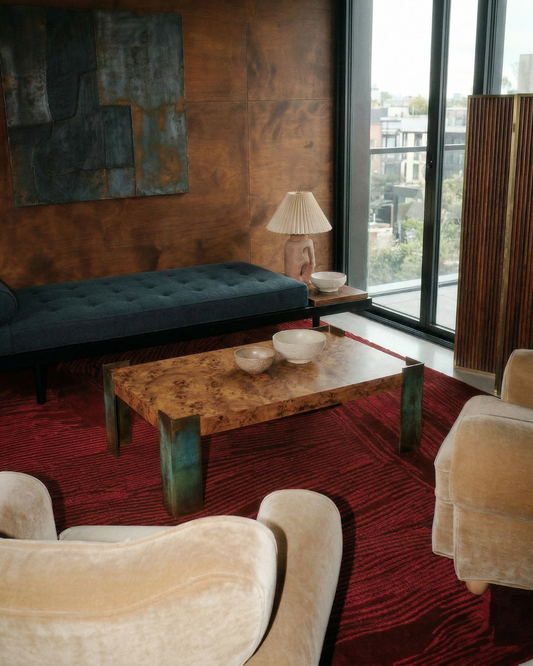
Op Art was born in the 1960s from a shared idea: a painted image can produce a sensation of movement in a motionless viewer. Victor Vasarely builds this vibration through grids and calculated geometric distortions. Bridget Riley achieves it through the repetition of lines and contrasts that tire and stimulate the eye. A rug like those of Optical Palazzo inherits directly from these two methods.
Where Op Art comes from and why it acts on the eye
The term Optical Art first appeared in 1964 in the American magazine Time, a year before the exhibition that established it for good: The Responsive Eye, presented at the Museum of Modern Art in New York in 1965. The principle is simple to state and demanding to achieve. An abstract composition, often in black and white or in bold colors, is arranged in such a way that perception begins to oscillate. The eye believes it sees a surface ripple, advance or pulse, even though it is perfectly flat and still.
This effect relies on known physiological mechanisms. The eye never fixes on a point in a completely stable way: it makes tiny involuntary movements. Faced with very regular, strongly contrasted patterns, these micro-movements create afterimages and interference effects that translate into a sensation of movement. Op Art is therefore not a matter of a simple taste for geometry. It exploits a precise knowledge of the way we see.
Vasarely, the engineer of geometric distortion
Victor Vasarely, born in Hungary in 1906 and settled in France, had a training that explains much of his method. He studied for a time at a school close to Bauhaus principles in Budapest, then worked for many years in advertising and graphic design in Paris. He approached composition as a reproducible system, based on a basic unit he called the plastic unit: a square containing a shape, whose color, size and orientation are varied.
His most famous signature is the Vega series, begun in the 1960s. In it, Vasarely takes a regular grid and inflates it from the center, as if an invisible sphere were pushing beneath the surface. The squares expand, the lines curve, and the plane seems to bulge toward the viewer. Everything is calculated: the distortion follows a rigorous mathematical progression. The vibration arises from the structure itself, even before color.
Vasarely also laid claim to a social ambition. He envisioned an art that was programmable, multipliable and accessible, whose rules could be passed on and carried out by others. This almost industrial dimension of his thinking naturally brings him close to the applied arts: screen printing, architecture, tapestry and, by extension, the rug.
Riley, vibration through line and repetition
Bridget Riley, born in London in 1931, starts from a different point. Her first notable works, in the early 1960s, are in black and white: undulating lines, series of triangles, fields of dots whose spacing varies regularly. A canvas such as Movement in Squares, from 1961, gradually compresses squares until the surface seems to fold in the middle.
With Riley, the effect comes not from a distorted central form but from the patient repetition of a motif in which a single parameter changes. The curve accelerates, the interval narrows, the inclination tips. The eye, unable to settle on this continuous progression, produces a flicker, a sensation of floating. From 1967, Riley introduced color and closely studied the way two neighboring shades influence each other, following the research of Josef Albers on the interaction of color.
What Riley called "the experience of looking" places the viewer at the center: the work is completed only in the act of perception.
Where Vasarely builds an open, transmissible system, Riley refines a sensation, drawn by hand and then executed with her assistants according to precise instructions. Both artists work with rigor, but one thinks in modular units and the other in continuous progressions.
How these principles carry over into a rug
The hand-tufted rug is a surprisingly faithful medium for Op Art, provided you understand its constraints. The weave imposes a grid: each tuft of wool occupies a regular position, exactly like the cells of a Vasarely composition. This orthogonal structure lends itself to the calculated distortions and controlled repetitions that make the surface vibrate.
The material adds a dimension that painting does not have. New Zealand wool and silk do not return light in the same way: the first absorbs and diffuses it, the second reflects it and changes intensity with the viewing angle and the time of day. An optical pattern woven to play on these two fibers begins to shimmer as you move around the rug, which extends into real space the instability that Riley and Vasarely sought.
The Optical Palazzo collection works precisely on this ground. Some designs take up the logic of central swelling inherited from Vega, where a grid expands to suggest a volume beneath the plane. Others exploit the continuous progression dear to Riley, tightening or tilting a motif line after line. Carving, the technique of sculpting the surface of the wool at different heights, can reinforce the illusion by creating real shadows that accompany the purely optical ones drawn by the pattern.
Understanding these two legacies changes the way you look at an optical rug. Behind the immediate sensation of movement, there is a century of research on perception, a rigorous weaving grid and the precise choice of fibers that respond to light. It is this accumulated knowledge that sustains the vibration, from the painted panel of the 1960s to the floor of a present-day interior.