Op Art, or optical art, is an artistic movement born in the 1960s that exploits the mechanisms of visual perception to produce illusions of movement, depth and vibration in abstract compositions. Bridget Riley, Victor Vasarely, Richard Anuszkiewicz: these artists showed that a flat surface, covered with repeated geometric shapes, could produce real physical effects on the viewer. The eye does not settle; it slides, it oscillates, it is thrown off balance.
What these painters discovered on canvas, Rugier translates into wool. Our collections of contemporary rugs with geometric patterns draw directly on this legacy to turn the floor into an active surface, an optical plane.
What is Op Art?
Op Art, short for Optical Art, emerged in the United States and Europe in the 1960s, in reaction to Abstract Expressionism. Where the latter valued gesture and emotion, Op Art is concerned with perception: how the eye processes visual information, which geometric configurations create illusions, how the repetition of a simple motif can produce an impression of vibration or movement.
The founding exhibition "The Responsive Eye," held at MoMA in New York in 1965, established the movement with the general public. Bridget Riley showed her black-and-white canvases with their hypnotic undulations. Vasarely showed his distorted grids, which seem to swell or sink inward. Op Art entered the history of contemporary art.
Victor Vasarely and active geometry
Victor Vasarely is the guiding figure of European Op Art. Born in Hungary and trained at the Budapest Bauhaus, he developed from the 1950s onward a visual vocabulary based on the repetition of simple shapes: squares, circles, diamonds, hexagons, arranged in grids that seem to bulge, sink inward, or turn on themselves.
What is fascinating in Vasarely's work is that the illusion is not a sleight of hand: it is the result of precise calculation, of a rigorous understanding of how the eye perceives color and form. His compositions do not move. It is the eye that moves.
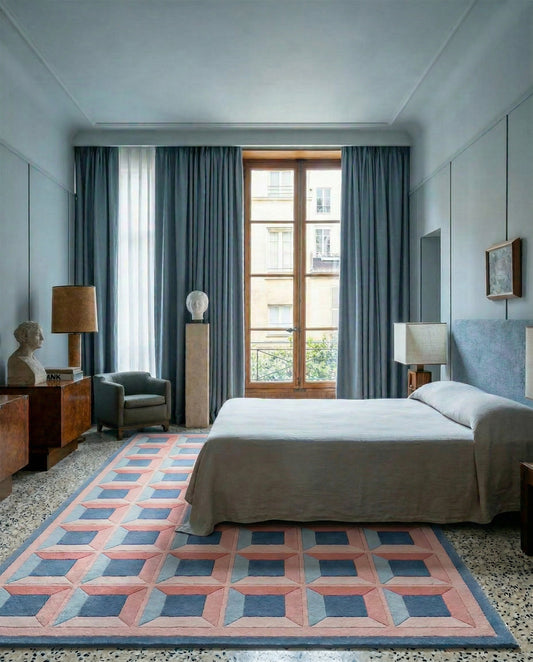
This is exactly the principle that structures Rugier's Optical Palazzo collection: repeated architectural motifs, constructed perspectives, a surface that seems to have several depths although it is perfectly flat.
Bridget Riley and visual vibration
Bridget Riley works differently from Vasarely. Where he builds spaces, Riley creates frequencies. Her series of slightly undulating parallel lines and her repeated curves produce a sensation of vibration, almost of physical unease. The eye cannot find an anchor point.
Her works of the 1960s, entirely in black and white, are among the most radical of the period. They prove that color is not necessary to produce an impression of movement. Structure is enough.
Rugier's Moire collection follows in this lineage: the moiré effect, produced by overlaying or slightly offsetting repeated patterns, creates a surface that seems alive, constantly moving depending on the viewing angle and the light.
The moiré effect: when the rug seems to move
The moiré effect is an optical phenomenon that appears when two grids of lines or patterns overlap with a slight offset. The result is a third, ghost image that seems to float above the surface. In photography, it is often an unwanted artifact. In optical art and textile design, it is a tool.
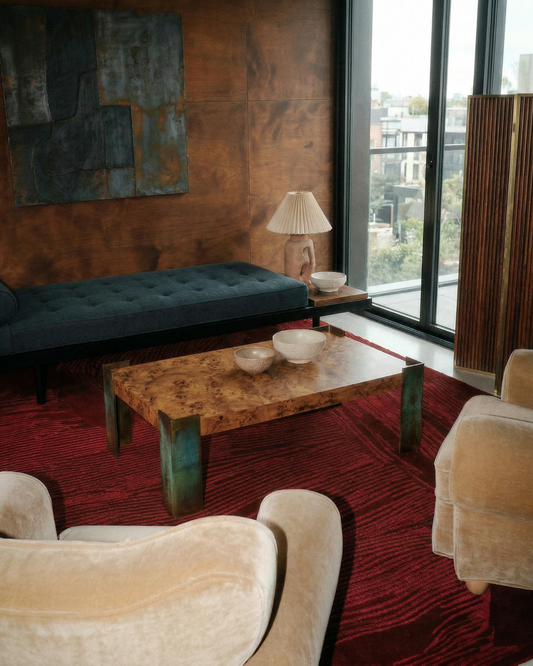
Applied to a hand-tufted rug in New Zealand wool, the moiré effect takes on an additional dimension: the very texture of the wool, its natural sheen, amplifies the phenomenon. The rug changes appearance as you move around the room, with the time of day, and depending on whether the light is natural or artificial. It is a living object.
Geometry and relief: the contemporary rug as sculpture
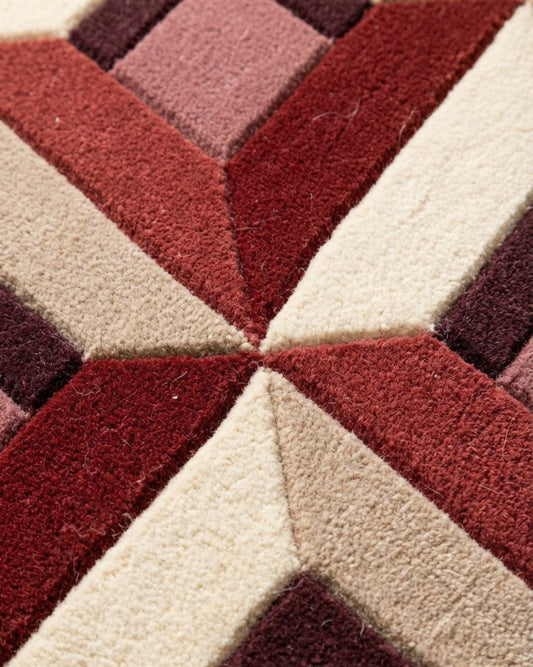
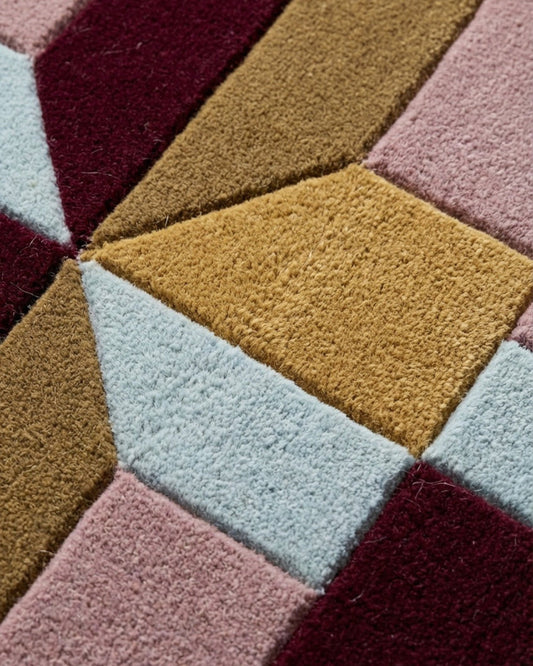
Op Art works on flat surfaces. The hand-tufted rug offers an additional dimension: relief. Through the technique of carving, or chiseling, it is possible to sculpt the surface of the rug to create differences in height between motifs. A geometric shape can thus literally stand out from the background, cast a shadow on itself, and exist in space in more than two dimensions.
The Rugier collections use this technique to give optical motifs an architectural presence. The rug is no longer just an image on the floor: it is a relief, a topography, a design object in its own right.
The contemporary geometric rug: how do you bring it into an interior?
A rug with strong optical patterns calls for a little care in how it is brought into a room. A few simple principles help make the most of it.
In a pared-back interior, with white walls and understated furniture, a geometric rug with an optical effect can be the only strong element in the room. It structures the space without weighing it down.
In a busier interior, it is better to choose a colorway in neutral or muted tones so that the pattern stands out through its structure rather than its color.
Size matters as much as pattern: a geometric rug that is too small loses its effect. Plan for a generous size, 200x300 cm minimum in a standard living room, so that the optical play has room to unfold.
At Rugier, each collection starts from an idea. Optical Palazzo, Moire, La Pintura: these names are not marketing labels; they are references. Entry points into a visual history that begins with Vasarely and Riley, passes through Memphis and the radical design of the 1980s, and reaches all the way to the floor of your apartment.
A rug with an idea behind every pattern. Discover the collections at rugiertextiles.com.