Memphis is a design collective founded in Milan in 1981 around Ettore Sottsass. Its furniture, with its bright colors, printed laminates and disorderly geometric shapes, broke with the prevailing functionalism. Within a few seasons, the group had become the face of postmodernism applied to furniture.
A winter evening in 1980 at Ettore Sottsass's home
The story begins in Ettore Sottsass's Milan apartment, one evening in December 1980. Around him, a handful of designers, including Michele De Lucchi, Aldo Cibic, Matteo Thun and Marco Zanini, are discussing a joint project. A Bob Dylan record is playing on repeat, Stuck Inside of Mobile with the Memphis Blues Again. The word Memphis sticks. It condenses two references: the Tennessee city, cradle of rock and of Elvis, and the ancient Egyptian capital. This double reading, popular culture and grand history, already sums up the group's ambition.
Sottsass was no beginner. Born in 1917, he had a considerable career behind him, notably as a consultant for Olivetti, where he had designed the famous Valentine typewriter, red and portable. At over sixty, he brought together a younger generation to launch a collective venture, officially presented at the Milan Furniture Fair in September 1981.
A visual shock at the Milan Fair
The first Memphis presentation took place on September 18, 1981, in the Arc'74 showroom. The crowd was so large that the street was blocked. What visitors discovered upended established codes: furniture in garish colors, laminate patterns recalling terrazzo, shelves that seemed to defy any logic of use.
The most emblematic piece is the Carlton bookcase, designed by Sottsass. Its shelves branch out at an angle, like the arms of a totem, in a riot of color. It does not seek storage efficiency: it asserts a presence, almost a figure. Alongside it, the Tahiti lamp, in the shape of a stylized bird, and Peter Shire's Bel Air armchair, with its asymmetrical legs, extend this formal freedom.
The group quickly became international. The Italians were joined by Austrian Hans Hollein, American Michael Graves, Japanese designer Masanori Umeda and French designer Nathalie Du Pasquier, whose textile patterns became a signature of the Memphis language.
Memphis rests on a recognizable vocabulary. Color is saturated, often applied in flat areas without gradation: candy pink, bright yellow, turquoise, deep black. The shapes borrow from the elementary geometric repertoire of the triangle, the circle and the zigzag, but assemble them according to a logic of rupture rather than of balanced composition.
The group's favorite material is plastic laminate, long considered a cheap surface for kitchens and counters. Memphis raised it to the rank of a noble material through its choice of patterns. Nathalie Du Pasquier and George Sowden designed spotted, speckled prints, scattered with small colored dashes, which were applied to entire volumes of furniture.
"Design, for me, is a way of discussing life, society, politics, eroticism, food and even design," said Ettore Sottsass, refusing to reduce the object to its function alone.
This repurposing of plastic and industrial pattern carries a precise idea: furniture can be decorative, joyful, ironic, without having to justify itself through performance. It is a head-on stance against the modernist doctrine of functionalism, inherited from the Bauhaus, which held that form should derive strictly from use.
Memphis, a laboratory of postmodernism
To understand Memphis, you have to place it within postmodernism, the movement that, from the 1970s onward, called into question the certainties of the modern movement. In architecture, Robert Venturi had summed up this shift in his book Complexity and Contradiction in Architecture (1966), arguing for ambiguity and ornament against functionalist purity. Memphis applied this thinking to furniture: quotation, mixing of registers, refusal of any hierarchy between high culture and mass culture.
The group also belongs to an Italian lineage. From the late 1960s, the radical movement, with Archizoom, Superstudio and Studio Alchimia, to which Sottsass and De Lucchi were close, challenged good taste and consumerism. Memphis is its most visible culmination, the one that reached the general public and the pages of international magazines.
The adventure was brief. Sottsass left the group in 1985, considering its mission accomplished, and Memphis ceased its activities in 1988. Barely seven years, but a lasting influence on graphic design, fashion, set design and the visual culture of the 1980s. Karl Lagerfeld had furnished his Monte Carlo apartment entirely with Memphis pieces, proof of the movement's immediate resonance.
Nostalgia Plastica: the Memphis spirit woven into wool
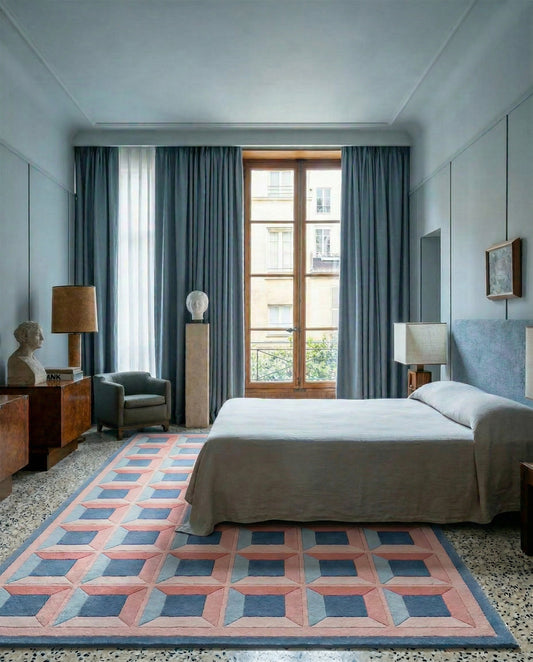
The Nostalgia Plastica collection draws directly on this grammar. It brings back the playful geometry, the bold colors and the spirit of free composition that were the signature of Sottsass and his companions. The reference is not decorative in a superficial sense: it embraces the postmodern legacy, the idea that the floor of an interior can carry a joyful, rhythmic pattern that is almost graphic.
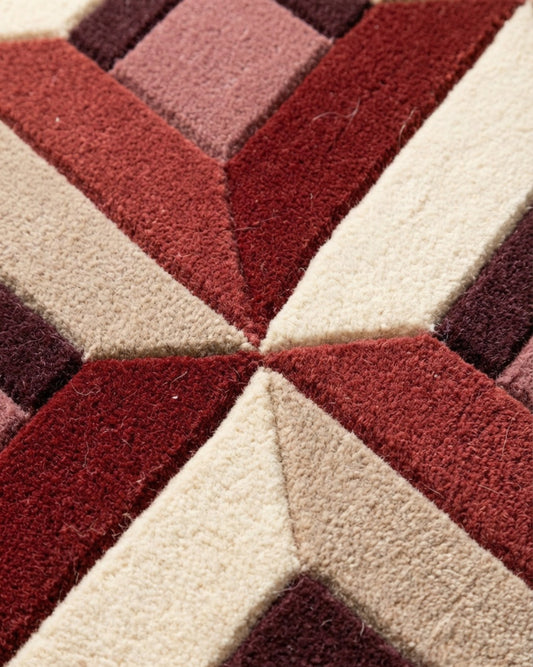
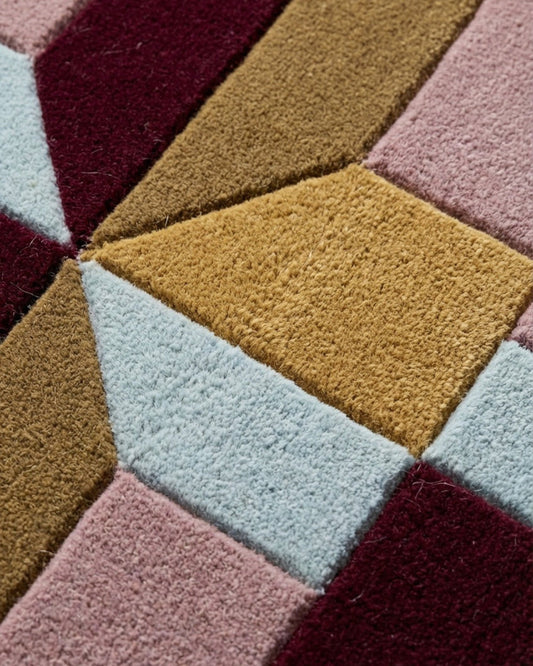
Translating this language into a hand-tufted rug requires precise work. The crisp flat areas of color, essential to the Memphis vocabulary, demand mastery of the outline and careful dyeing of New Zealand wool. Where laminate offered Sottsass a flat, smooth surface, wool and silk bring a depth of material unknown to the screen or to plastic, while respecting the original vividness of color. The spirit of 1981 thus continues to circulate, transposed into a craft technique that the Milan group would hardly have disowned.