Art Deco made the geometric rug a language in its own right in the 1920s. The 1925 International Exhibition of Decorative Arts in Paris set its vocabulary, Ivan Da Silva Bruhns gave it its checkerboards and chevrons, and transatlantic ocean liners spread it around the world.
Why 1925 remains the pivotal date of the modern rug
In 1925, Paris hosted the International Exhibition of Modern Decorative and Industrial Arts. Much later, it would give its name to the style known as Art Deco. For six months, around the Pont Alexandre III and Les Invalides, pavilions, galleries and reconstructed interiors presented a new aesthetic: taut lines, clear-cut symmetries, stylized motifs borrowed from the flower, the rising sun, the fountain or the zigzag. The rug held a central place there, because it was the first medium capable of translating this vocabulary onto the floor, on a large scale and in color.
What was at stake went beyond decorative fashion. Art Deco sought to reconcile ornament and production, luxury craftsmanship and the industrial line. The rug suited this program perfectly: it demands considerable manual skill while accepting a rational composition, drawn with ruler and compass. Geometry here is not an impoverishment of the motif; it becomes its grammar.
A geometric vocabulary drawn from several sources
Art Deco geometry did not come from nowhere. It absorbed the influence of the Viennese workshops, the avant-gardes' lesson in rigor, and a keen interest in so-called primitive arts, African and Native American in particular, whose compositions in registers and diamonds informed the design of many rugs. At the same time, other movements pushed the grid toward pure abstraction, as can be read in the history of the De Stijl movement and its conviction that geometry can do everything.
Where De Stijl reduced composition to the orthogonal and the primaries, Art Deco kept a taste for decoration: borders, cartouches, gradients, fan motifs. The rug became a dense object, structured like architecture, with a central field, frames and elaborate corners. This way of thinking of the floor as a composed surface still runs through the way you can start from the rug to compose an entire room.
Ivan Da Silva Bruhns, the geometer of the rug
No name embodies the Art Deco rug better than that of Ivan Da Silva Bruhns. Born in 1881, this Frenchman of Brazilian descent discovered the rug by observing pieces from North Africa in a hospital during the First World War. He drew a conviction from this: the rug can be a work of composition, drawn like a painting and designed to converse with the furniture.
His creations established a recognizable language: offset checkerboards, chevrons, nested diamonds, brown, ochre and fawn grounds heightened with black. He set up a workshop in Savigny-sur-Orge and worked for the greatest decorators of the era, including Jacques-Émile Ruhlmann. His rugs were hand-knotted on a precise grid, each module calculated to align with the next. This demand for a rigorous grid is exactly the one followed today by a contemporary rug-making workshop, even when the technique differs.
At Rugier, rugs are hand-tufted rather than hand-knotted like those of Da Silva Bruhns, but the legacy of composition remains. The process of translating a geometric design into a regulated grid is described in our article on how a pattern is born, from gesture to grid.
Ocean liners, floating showcases of the style
The Art Deco rug found its greatest stage on the water. The French transatlantic lines, engaged in a competition for prestige, turned their ships into manifestos of national taste. The Île-de-France in 1927, the Atlantique in 1931, then the Normandie in 1935 carried furniture, lacquerwork, glassware and rugs signed by the finest workshops. Da Silva Bruhns laid entire floors there, designed for the lounges, smoking rooms and grand staircases.
On an ocean liner, the rug is not merely decorative. It structures immense spaces, guides circulation and absorbs the noise of a crowd in motion. This dual function, aesthetic and acoustic, remains at the heart of the contemporary rug, as our article on the wool rug, an acoustic and thermal regulator for a room points out. Crossing the Atlantic, these ships also carried the Art Deco style to the United States, where it left its mark on hotels, movie theaters and building lobbies.
What the contemporary rug keeps from Art Deco
A century later, the Art Deco lesson remains active. The structured grid, the repeated motif, the border that frames the field, the clear contrast between a few colors: these principles continue to organize the geometric rug, as shown by the still-living history recalled in Art Deco is a hundred years old, and in great shape. They can be found in the enduring taste of grand interiors for regularity, including in the reason why grand hotels have geometric rugs.
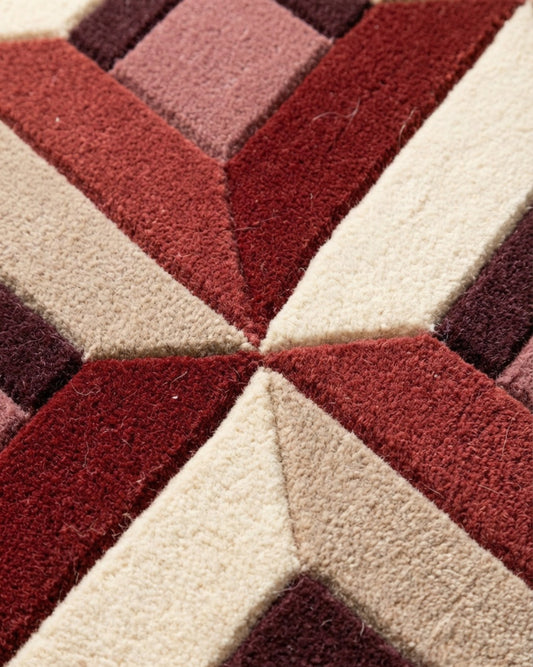
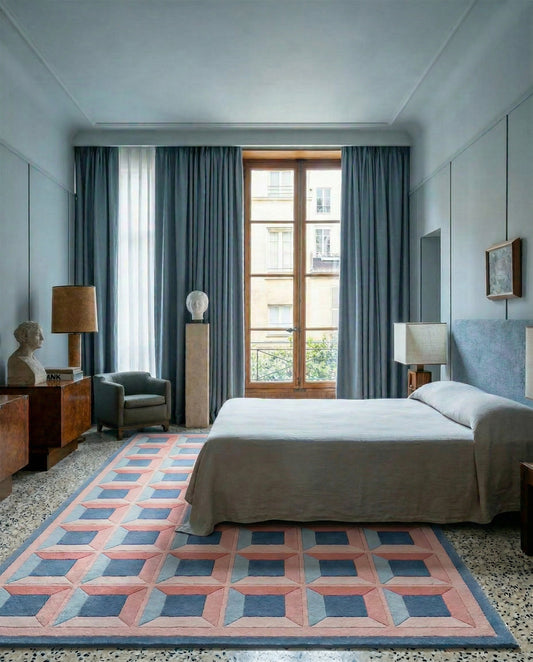
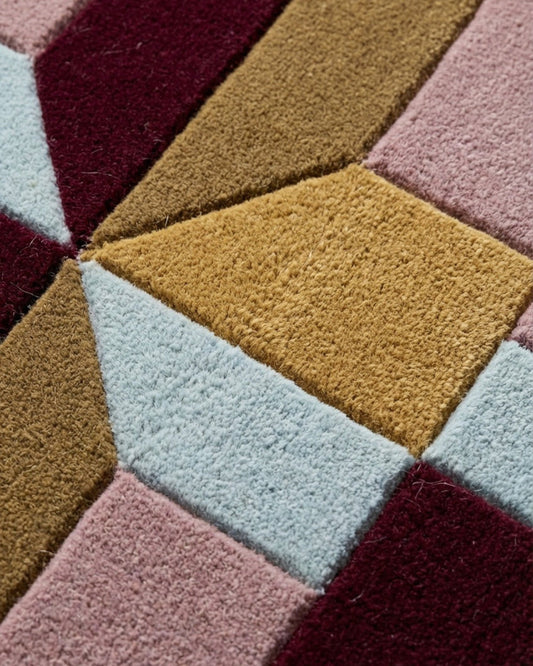
At Rugier, this legacy informs several collections. The checkerboards and perspectives of the Optical Palazzo collection extend the Art Deco fascination with the regulated grid, while custom design makes it possible to take up these principles at the exact scale of a room. Composing a grid suited to a living room or an entrance hall is done today in Studio Rugier, where you design your custom rug, in the same spirit of harmony between design, color and space that already drove the workshops of 1925.