A rug can work as the starting point of a room rather than its finishing touch. By setting the palette, the scale and the material atmosphere of the floor from the outset, it provides a framework to which the furniture, the walls and the light respond. It is a method of composition, not a constraint.
In most interiors, the rug comes last. You choose the sofa, paint the walls, accumulate objects, then look for a floor surface capable of reconciling everything. This logic works, but it reduces the rug to an adjusting role. There is another approach, older than it seems: making the rug the first decision, the one that guides all the others.
In the great residences of the East as in the European salons of the 17th century, the rug was not an accessory. It structured space, marked out reception areas, and often dictated the color harmony of the room. Its long and costly making made it a piece around which everything else was organized. Thinking of a custom rug as the centerpiece means reconnecting with this hierarchy.
Why starting with the floor changes the composition
The floor is the largest continuous surface in a room, often larger than any clear wall. A color or pattern that appears on it occupies the field of vision more steadily than a painting or a curtain. Deciding on this surface first amounts to setting the root note of a chord: everything that follows is read in relation to it.
This initial choice also frees up the rest of the work. Once the rug's palette is settled, the number of possible decisions for the walls and furniture naturally narrows, not through impoverishment but through coherence. You no longer search at random: you respond to a framework already defined. The Bauhaus designers, who thought of the interior as a system of related elements, reasoned exactly this way, first establishing relationships of proportion and color before adding objects.
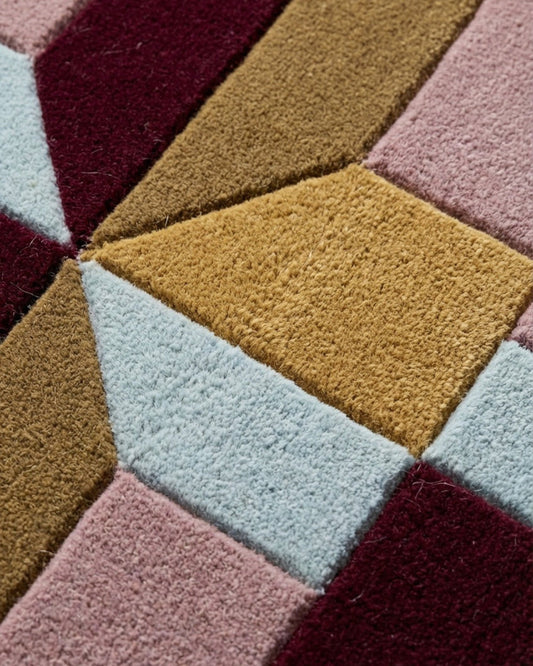
A rug rarely contains a single color. It offers a chord: a dominant hue that covers most of the surface, one or two secondary colors that structure the pattern, and often a minor accent, present in a few percent of the composition. This distribution is a guide that can be transposed directly to the room.
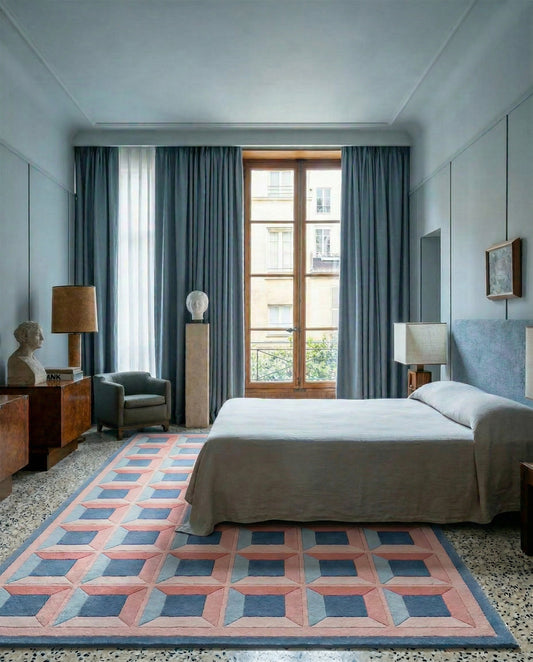
The most useful rule of thumb remains that of decreasing proportions, sometimes formulated as 60-30-10: the rug's dominant becomes the color of the large neutral surfaces (walls, surrounding floor), the secondary dresses the main furniture, and the accent, that red or bright blue isolated in the rug, reappears on cushions, a lamp, an object. The eye then perceives continuity, without anything being matched in the literal sense.
A rug that is read well already contains the color plan of the entire room: you only need to distribute its proportions across the other surfaces.
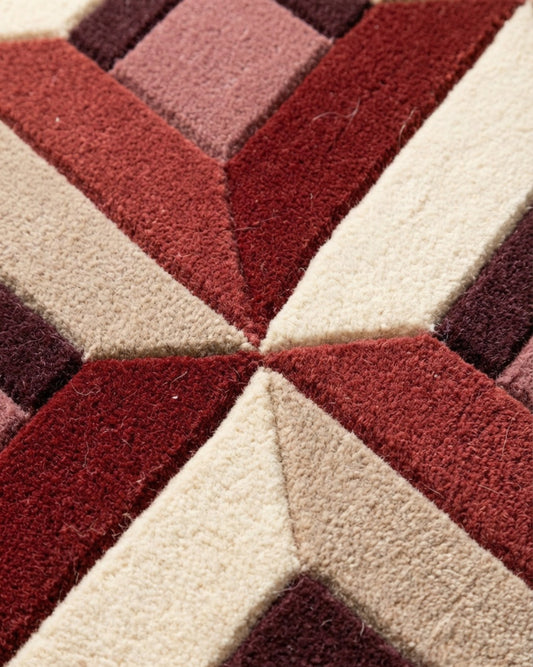
This reading also applies to collections with a strong graphic character. An Op Art-inspired rug, playing on contrast and optical movement in the manner of Bridget Riley or Victor Vasarely, calls for a calm environment that lets it breathe. Conversely, a rug in muted tones with a sculpted texture can handle bolder furniture around it.
Making materials converse, not just colors
Composition is not only a matter of hues. The material of a rug, New Zealand wool that is dense and matte, silk that catches and returns light, sculpted relief that creates shadows, enters into a dialogue with the other surfaces of the room. A thick, textured wool balances smooth, lacquered furniture; a glossy silk finds its echo in glass, polished metal and reflective surfaces.
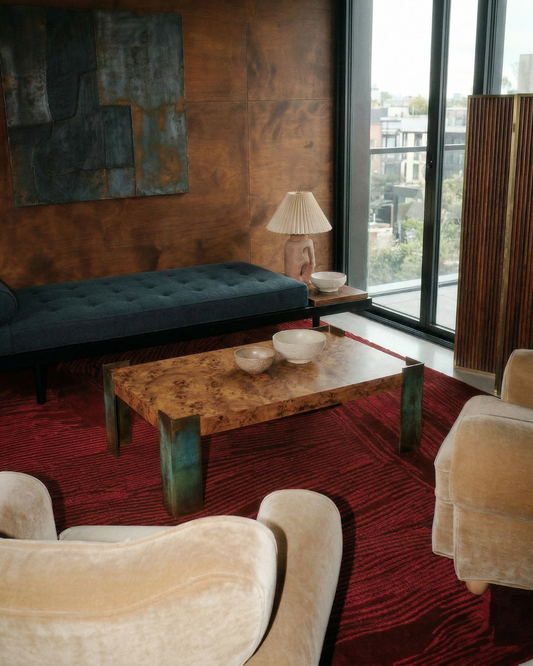
Relief also comes into play. Carving techniques, which sculpt levels into the thickness of the pile, produce plays of shadow that vary with the time of day and the lighting. Such a rug lives differently in the morning and in the evening, which invites you to plan the room's lighting around it: raking light reveals the relief, overhead light flattens it. Composing around the rug also means orchestrating the way light passes across it.
Scale, pattern and furniture placement
A rug conceived as the centerpiece must be sized to anchor the furniture, not to float in the middle of the room. The most reliable convention is to rest at least the front legs of the main seating on the rug, so that the whole forms a coherent island. A rug that is too small fragments the space; a generous rug brings it together.
Finally, the pattern dictates the layout. A strongly centered or symmetrical design calls for an arrangement that is itself centered, with sofas and armchairs organized around its axis. A repeating pattern or an all-over design, with no focal point, allows instead a freer placement of furniture. Observing the internal structure of the rug before placing the furniture avoids working against its visual logic.
The custom rug as the starting point of the project
Designing the rug yourself reverses the whole usual process. Instead of looking for a piece that fits an existing interior, you first define the surface that will govern the space. It is an act of design in the full sense: choosing the shapes, the colors, the materials and the scale, then deducing the rest of the room from them.
This is precisely the purpose of Studio Rugier, where you compose your rug in dialogue with the tufters of Bhadohi. Each decision, an interval of color, a contrast of materials between wool and silk, a sculpted relief, shapes the future composition of the room. The rug then becomes what it long was: the foundation stone of an interior, not its final word.