A rug pattern is born from a drawing, but takes shape in the material. Between the screen of Studio Rugier and the finished rug in Bhadohi, every choice of proportion, repetition and rhythm is translated into precise gestures, line of wool after line of wool. Understanding this journey means learning to draw for the artisan's hand as much as for the eye.
A rug always begins with a graphic intention: a geometry, a dominant color, a desire for movement. But between this first idea and the object laid on the floor, there is a chain of decisions and gestures that few people have the chance to observe. This is the journey we invite you to follow, from the digital sketch to the weave of wool and silk tufted in the workshops of Bhadohi, in India.
Composing a rug in Studio Rugier amounts to setting the first coordinates of this journey. You choose a shape, a palette, a material, a scale. None of these settings is a mere decorative parameter: each one determines what the artisan's hand will have to accomplish, week after week, to bring the drawing to life.
Drawing, the first grammar of the rug
Every pattern rests on a grammar: units that repeat, space out, answer one another. It is the shared vocabulary of the history of textile design, from Persian interlacing to the rigorous compositions of the Bauhaus, where Anni Albers studied precisely how a weave imposes its logic on the design. When you sketch a shape in the Studio, you are already defining these units: a circle, a band, a geometric fragment destined to multiply.
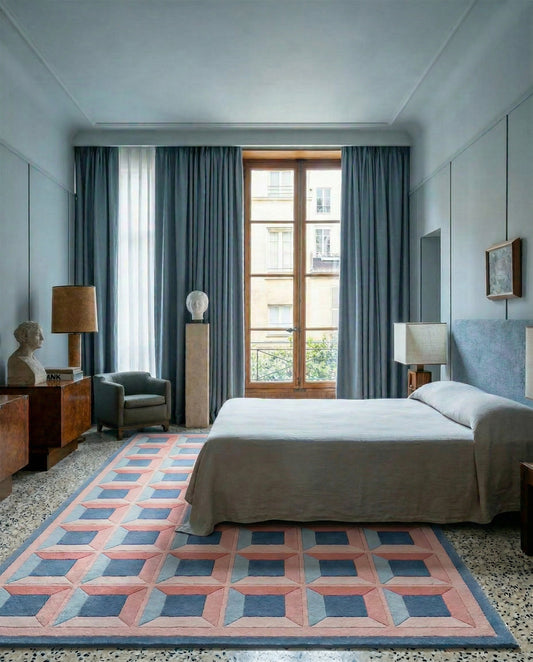
Proportion is the first structuring decision. A pattern that works on a twenty-centimeter screen can fall apart at the scale of a three-meter rug, or on the contrary gain an unexpected breadth. Op Art designers such as Victor Vasarely and Bridget Riley knew this law: an enlarged module does not simply produce a larger image; it changes the way the eye travels across it. Drawing a rug means anticipating this reading on the floor, from a distance, under the light of an interior.
Repetition and rhythm: the mechanics of the gaze
Repetition organizes the visual field. A motif that repeats at a regular interval brings calm and stability; an interval that varies creates tension and movement. The compositions of De Stijl, in the work of Mondrian or van Doesburg, played on these gaps: a few lines, a few flat areas of color, but proportions calculated so that nothing is inert.
Rhythm, for its part, comes from alternation: solids and voids, warm and cool colors, dense zones and breathing spaces. In Studio Rugier, adjusting the spacing between two shapes or varying a color from one module to the next amounts to composing this score. The artisan will later play it strand after strand, respecting every interval decided beforehand.
A pattern does not merely occupy a surface: it guides the movement of the eye, slowing down here, speeding up there, like music inscribed in wool.
From the screen to the technical drawing in Bhadohi
Once the composition is approved, the drawing leaves the digital world to become a working document. In Bhadohi, the world capital of the handmade rug, this drawing is transferred at full size onto a stretched cotton cloth, which will serve as the backing for tufting. Every color area is traced on it, every outline drawn, because the artisan works on the reverse side of the cloth, following this tracing like a map.
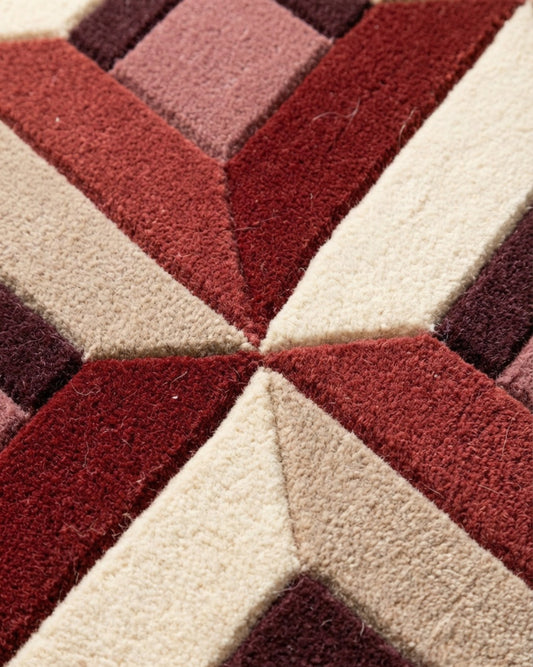
The hand tufting technique relies on a tufting gun that inserts strands of wool or silk through the cloth, loop after loop, following the drawing. It is a physical, continuous gesture, in which the steadiness of the hand determines the sharpness of the pattern. A straight line, a clean curve, a precise boundary between two colors: everything depends on this mastery, acquired over years of practice.
How the material translates the pattern
New Zealand wool and silk do not render a design in the same way. Wool, matte and dense, absorbs light and gives the pattern a muted, stable, warm presence. Silk, smooth and reflective, catches the light and makes the outlines vibrate; it is often used to highlight a detail, bring out a line, or create a contrast of sheen within the same color.
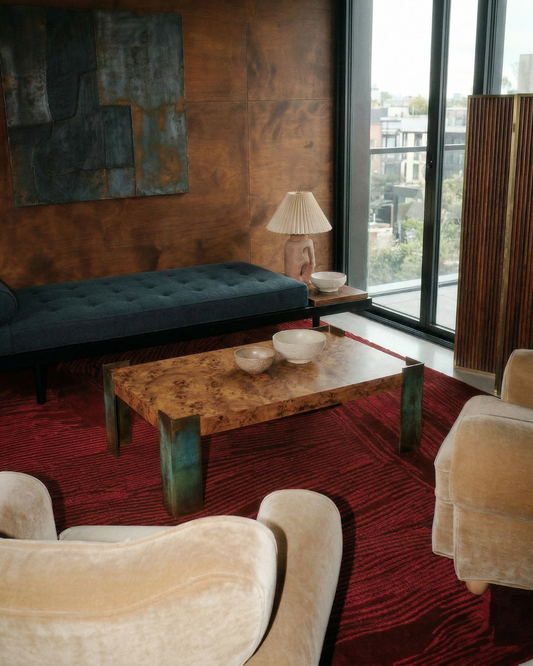
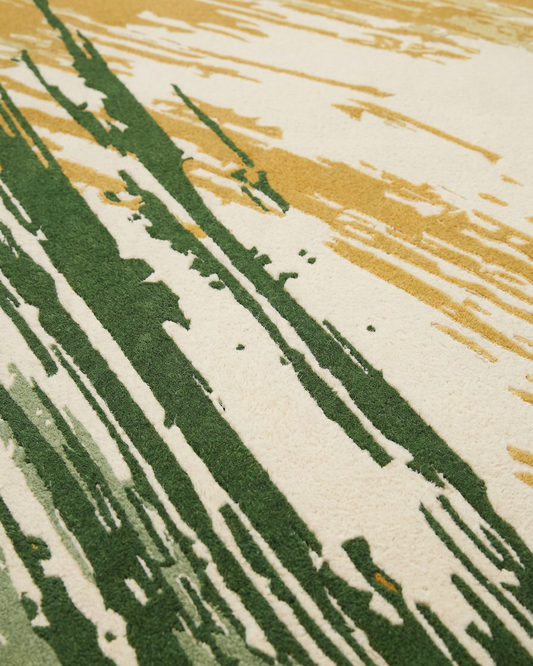
Relief also comes into play. The technique of carving, or pile sculpting, consists of cutting the wool at different heights to create a design in hollows and raised areas, as in our La Pintura collection. A pattern that is purely graphic on screen can thus acquire a third, tactile dimension, which changes the way it catches shadow. What is decided on the surface extends into the depth of the material.
Finally comes the finishing: once tufting is complete, the back of the rug is coated to fix the tufts, then the surface is sheared and sculpted to reveal the pattern in all its sharpness. The colors, somewhat raw until then, reach their exact shade after washing and drying. The design composed a few weeks earlier on a screen now exists as an object, certified by GoodWeave, carrying the memory of every gesture that brought it into being.
Designing a rug in the Studio therefore means entering into a long-distance dialogue with the workshop: what you draw, someone will tuft. Creative freedom is never abstract there; it is always measured in wool, in silk and in hours of patient work. Perhaps that is the real pleasure of custom work: watching an intention turn into material, and understanding, along the way, all the know-how that a pattern contains.