Bhadohi, in the Indian state of Uttar Pradesh, is the largest center of handmade rug production in the world. The region has been weaving and tufting since the 16th century and today provides a livelihood for several million people spread across thousands of workshops and villages. Its craftsmanship, passed down from generation to generation, combines traditional knotting and contemporary tufting.
Southeast of the holy city of Varanasi, in the Ganges plain, an entire region lives to the rhythm of the loom. Bhadohi, long part of the Varanasi district before becoming a district in its own right, forms with the neighboring towns of Mirzapur, Khamaria and Gopiganj what is known as the Carpet Belt. It is here that most of India's production of hand-knotted and hand-tufted rugs is concentrated, a craft that has shaped the economy and the social landscape for several centuries.
Rugier has its collections made in Bhadohi, in New Zealand wool and silk, in GoodWeave-certified workshops. Understanding this territory means understanding the origin of the gesture that gives birth to each rug.
A tradition born in the Mughal era
The history of the rug in Bhadohi dates back to the 16th century, during the reign of the Mughal emperor Akbar. The Mughal court, shaped by Persian culture, brought master weavers from Iran to set up workshops in northern India. These artisans brought with them Persian knotting, its floral motifs, its central medallions and its compartmented borders.
According to local tradition, a group of Persian weavers is said to have settled in the villages around Bhadohi, drawn by the quality of the Ganges water, useful for washing wool, and by the availability of farm labor between seasons. The craft took root, was passed down from father to son, and gradually adapted to the tastes and materials of the region. Over the generations, the Persian vocabulary blended with Indian repertoires to create an identity of its own.
The largest handmade rug hub in the world
Today, Bhadohi's Carpet Belt is recognized as the world's leading center for the production of hand-knotted and hand-tufted rugs. The activity sustains thousands of villages across several districts and provides a livelihood for several million people, among them weavers, dyers, washers, shearers, designers and traders.
The Bhadohi rug has obtained a protected geographical indication in India, a status that officially recognizes the link between the product and its territory, as with an appellation wine or cheese. The town is also home to the Indian Institute of Carpet Technology, the only institution in the country entirely dedicated to training and research in the field of rugs, proof that this artisanal craftsmanship goes hand in hand with a structured transmission of technical knowledge.
Knotting and tufting: two gestures, one workshop
Two main families of production coexist in Bhadohi. The hand-knotted rug, the older of the two, is made on a vertical loom on which the weaver ties thousands of strands of wool or silk, one by one, around the warp threads. Density is measured by the number of knots per square meter, and a large hand-knotted rug can require several months of work by several pairs of hands.
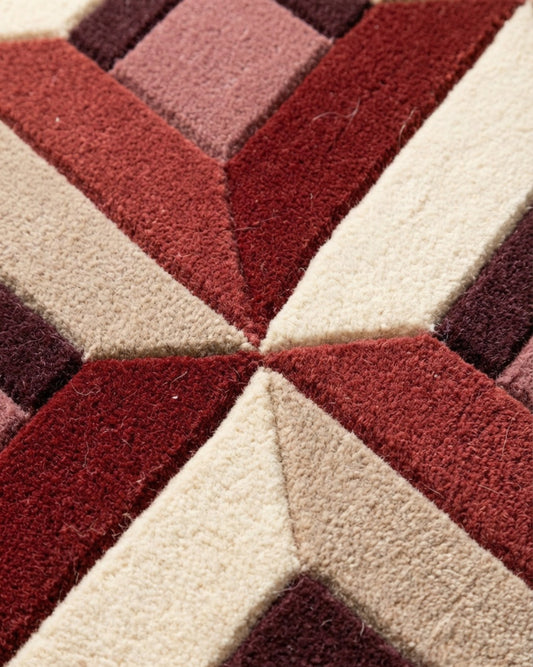
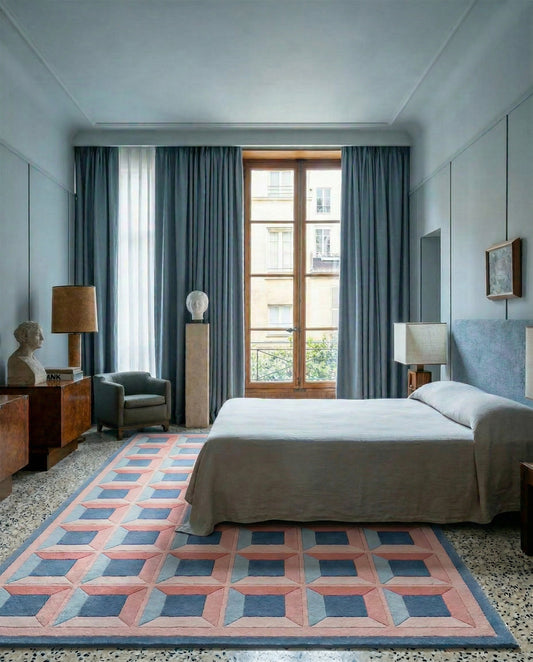
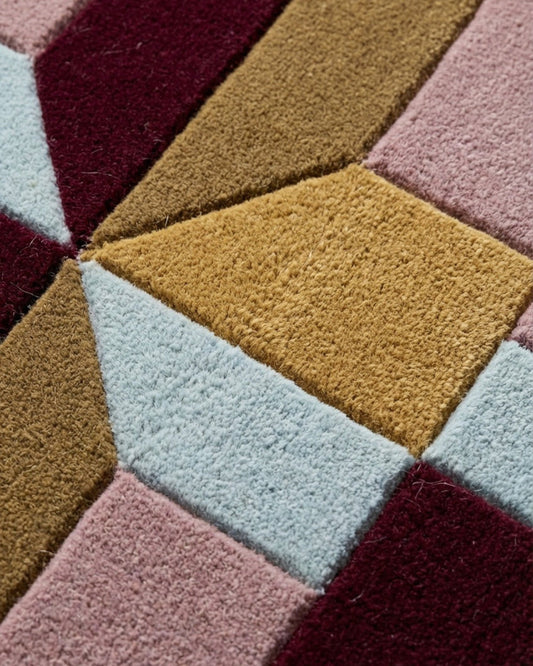
The hand-tufted rug, more recent, relies on a different gesture. The artisan transfers the design onto a stretched backing cloth, then inserts the tufts of wool with a hand-guided tufting gun, following the lines of the cartoon. The back is then coated and lined, and the surface is sheared and sculpted. This technique offers great freedom of design and relief, which makes it valuable for graphic collections such as those Rugier develops.
A hand-tufted rug is nothing like a mechanical product: each tuft is placed by an artisan who follows the design by eye, and the quality of the relief depends entirely on the sureness of their hand.
An ecosystem of workshops and trades
Bhadohi's strength lies in its organization as a chain of specialized trades. The process begins with the designer, who translates a composition into a cartoon coded color by color. Next comes dyeing: New Zealand wools, known for their long fiber and their luster, and silk are immersed in baths whose proportions are kept by the master dyers. Then come knotting or tufting, washing, drying in the sun, shearing and carving, the sculpting work that cuts reliefs into the surface.
This division of labor explains the flexibility of the region, able to produce classic pieces as well as contemporary creations demanding in relief and nuance. It also explains the vigilance required regarding manufacturing conditions.
GoodWeave and the question of fair labor
The rug industry in South Asia was long associated with child labor, an issue documented since the 1980s. It was in India, in this very region, that the initiative that became GoodWeave was born, founded by the activist Kailash Satyarthi, who was later awarded the Nobel Peace Prize in 2014.
GoodWeave certification rests on clear specifications: a ban on child labor, unannounced inspections in the workshops, traceability of production and funding for education programs. Choosing certified rugs, as Rugier does, means placing the artisanal gesture of Bhadohi within a framework where the passing on of craftsmanship goes hand in hand with respect for the people who carry it. This is the condition for a five-century-old tradition to keep living without betraying itself.