In Uttar Pradesh, in northern India, a single town accounts on its own for a considerable share of the world's production of handmade rugs. Bhadohi, also known as Sant Ravidas Nagar, has for centuries been the nerve center of a unique textile craft: the artisanal making of hand-knotted and hand-tufted rugs, exported to Europe, the United States and the rest of the world.
This is where the Rugier collections are born. Every hand-tufted rug in New Zealand wool that we design in Paris is made in the workshops of Bhadohi, by artisans trained in precision techniques that few regions in the world master to this level.
Bhadohi, world capital of the rug: a history spanning several centuries
The rug tradition in Bhadohi dates back to the 16th century, in the Mughal era, when Emperor Akbar brought master weavers from Persia to set up rug-making workshops in the region. These artisans brought with them the techniques of the Persian hand-knotted rug, floral motifs, geometric grids, a sense of color.
Over the centuries, the region developed its own character: an ability to produce rugs of great technical diversity, from the traditional knotted rug to the contemporary tufted rug, by way of the flat-woven rug and the kilim. Today, Bhadohi and the surrounding region, which includes Mirzapur and Varanasi, form one of the world's largest clusters of handcrafted rug production, employing several hundred thousand artisans.
The craft know-how of Bhadohi
What sets the workshops of Bhadohi apart from industrial production plants is the transmission of a manual know-how that cannot be mechanized. The hand-tufted rug demands precise mastery of the tufting gun, an exact reading of the design mock-ups, the ability to reproduce complex patterns to scale, and constant attention to the evenness of the surface.
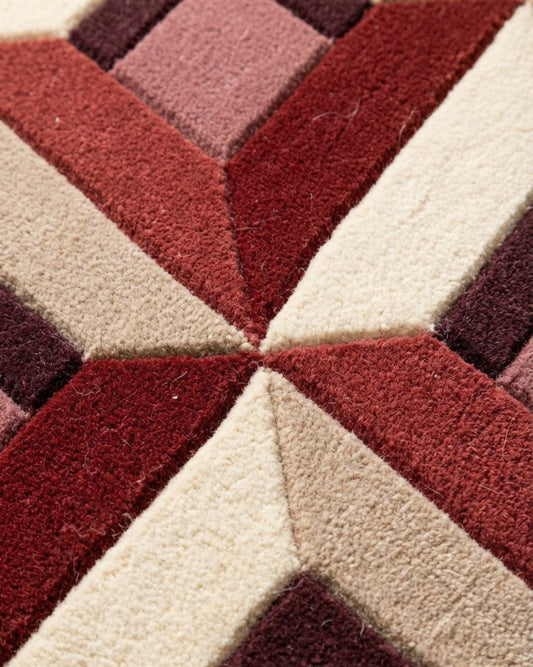
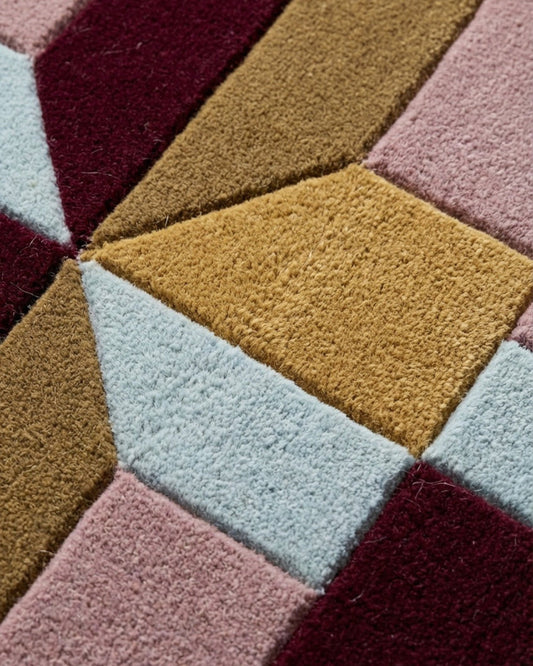
Carving, or chiseling, is one of the most demanding techniques: after tufting, the artisan sculpts the surface of the rug by hand, creating differences in pile height that give the pattern its relief and its depth. It is work that requires years of experience and precise knowledge of how wool behaves.
New Zealand wool, which we use exclusively at Rugier, is particularly demanding to work with: its long, dense fibers hold up well to carving but require a rigorous technique to achieve clean edges and precise reliefs. The artisans of Bhadohi have mastered these particularities.
GoodWeave certification: a concrete ethical commitment
GoodWeave certification is the international benchmark standard for the ethical production of handmade rugs. Founded in 1994 by the activist Kailash Satyarthi, winner of the 2014 Nobel Peace Prize, GoodWeave has the mission of ending child labor in the rug industry in South Asia.
A GoodWeave-certified rug guarantees three concrete things: no child labor in the production chain, regular unannounced inspections of the workshops by independent auditors, and a school re-enrollment program for the children identified during inspections.
All Rugier rugs are made in GoodWeave-certified workshops. This is not a marketing move: it is a fundamental requirement of our production process. Buying a Rugier rug means being certain that its making did not involve the exploitation of children.
Bhadohi and contemporary European design
Since the 1990s, Bhadohi has become the preferred manufacturing partner of the major European and American design houses. Furniture companies, interior designers, luxury brands: all turn to the workshops of Bhadohi to produce their collections of contemporary handmade rugs.
This partnership between Western design and Indian craftsmanship has profoundly transformed the region. The workshops have specialized in interpreting complex design mock-ups, developed new technical capabilities, and incorporated high-quality raw materials such as New Zealand wool, Tencel lyocell and natural silk.
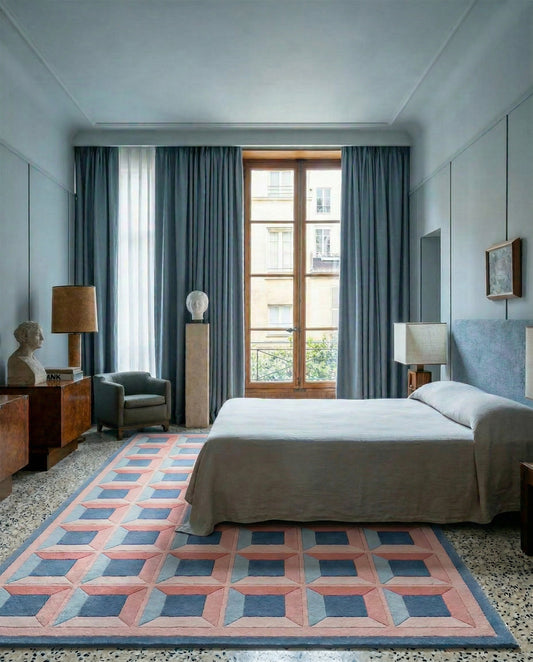
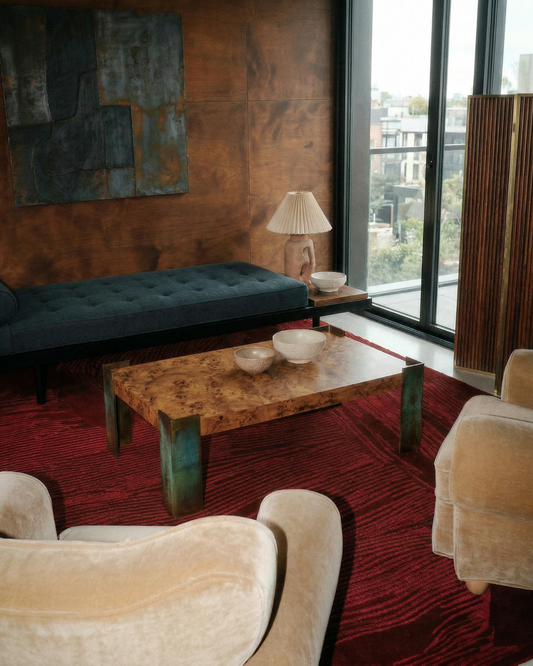
Rugier is part of this tradition of collaboration between European design and Indian craftsmanship. Our rugs are designed in Paris, in constant dialogue with the technical constraints and possibilities of the Bhadohi workshops. Design and know-how feed each other.
From New Zealand wool to the workshops of Bhadohi: the production chain of a Rugier rug
The making of a Rugier rug begins well before Bhadohi. The New Zealand wool is selected for the length and quality of its fibers, dyed in precise dye baths to match the collection palettes, then shipped to the workshops.
In Bhadohi, the artisans stretch the canvas over the tufting frame, transfer the pattern from the design mock-up, and begin the work strand by strand. For a 200x300 cm rug with a complex geometric pattern, the tufting alone can represent several days of work. Carving comes next, followed by the finishing of the latex-reinforced cotton backing, which gives the rug its stability and durability.
The result is a high-quality hand-tufted rug, handcrafted in accordance with GoodWeave standards, ready to last for decades in your home.
Why choose a handmade rug made in Bhadohi?
A handmade rug made in Bhadohi cannot be compared to an industrially produced rug. The density of the tufts, the precision of the carving, the evenness of the surface, the quality of the finishing: so many details that make the difference between an object that will last ten years and one that will last through several generations.
At Rugier, we work directly with the workshops, without intermediaries, which allows us to oversee every stage of production and maintain high technical standards on every collection.
A contemporary handmade rug, designed in Paris, made in Bhadohi. Discover the collections at rugiertextiles.com.