A wool rug works on three aspects of comfort: it absorbs part of the noise that travels through a room, it limits heat loss through the floor, and it offers a supple feel underfoot. These effects are not a matter of chance, but of the very structure of the wool fiber, which is porous, insulating and resilient.
People often choose a rug for its color or its design, and discover afterward that it has changed the atmosphere of a room in a way that is harder to name. Sound is more muffled, the floor less cold in the morning, walking gentler. These impressions have a precise physical explanation, linked to the nature of wool and to the way a tufted rug is constructed. Understanding these mechanisms helps you choose the right rug for the right use.
Why a rug absorbs noise
In a room, noise travels in two ways. There is airborne sound, voices, music, television, which travels through the air and bounces off hard surfaces. And there is impact noise, footsteps, a chair being moved, an object falling, which is transmitted directly through the floor. Bare tile or a bare wood floor reflects both types of sound; a room full of hard surfaces resonates and tires the ear.
A rug acts on both. Its fibrous surface, made of thousands of upright strands of wool, traps airborne sound waves in its interstices. The energy of the sound is not sent back into the room; it is converted into a tiny amount of heat through friction against the fibers. This is the principle of sound absorption, the same as that of porous wall panels, but applied to the floor.
For impact noise, the rug acts as a shock absorber. The pile and the textile backing absorb the impact of a footstep before it becomes vibration transmitted to the structure. This is why a room covered with rugs instantly seems calmer: both reverberation and footstep noise are reduced.
Wool, a fiber naturally structured for acoustics
Not all fibers absorb sound in the same way, and wool has particular advantages here. Seen under a microscope, the wool fiber is wavy: this is what is called crimp. This natural waviness prevents the fibers from packing down completely and maintains a constant volume of air between them. And it is precisely this trapped air that absorbs sound energy.
The New Zealand wool we use is known for this elasticity and its consistent fineness. Each strand resists crushing and recovers its shape, which ensures that the rug keeps its volume, and therefore its acoustic properties, over time. A dense, thick pile absorbs more than a short one: the fibrous mass available to trap sound is simply greater.
From cold floor to temperate floor: the thermal role of wool
The same structure that traps sound also traps heat. Wool is one of the most effective natural insulators, precisely because it holds a large amount of still air between its fibers. Still air conducts heat very poorly: this is the principle of any good insulator, from double-pane windows to winter clothing. A wool rug laid on a hard floor thus creates a barrier that slows the escape of room heat into the floor and cuts off the feeling of cold rising underfoot.
This effect is felt above all on hard mineral surfaces, concrete, stone, tile, which store coolness and release it on contact with the body. The rug adds a temperate layer that stays close to room temperature. Wool also has a rare ability: it absorbs and releases moisture from the air without feeling damp, which contributes to a steady sense of comfort through the seasons.
Wool fiber can absorb up to about a third of its weight in moisture while remaining dry to the touch, a property that contributes to the humidity balance of a room.
The tactile comfort of a rug comes down to one word: resilience, that is, the ability of the fibers to compress under weight and then spring back. The crimp of the wool acts here as a natural spring. The foot sinks in slightly, the material gives, then recovers its shape when you move. This suppleness explains the difference in walking between a bare floor and a room with rugs.
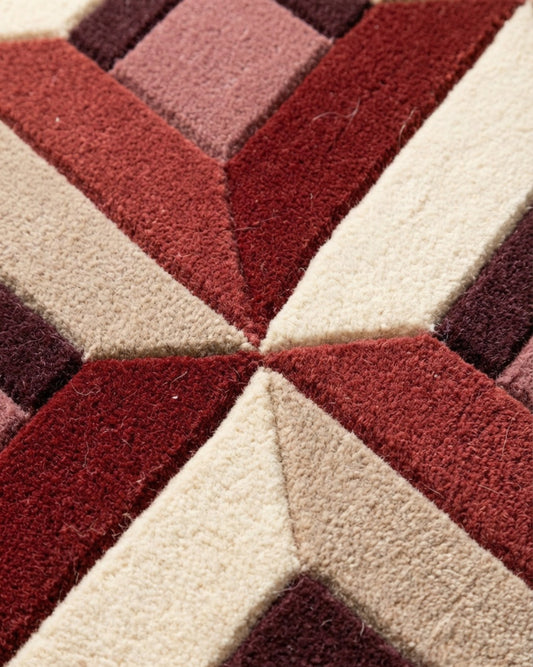
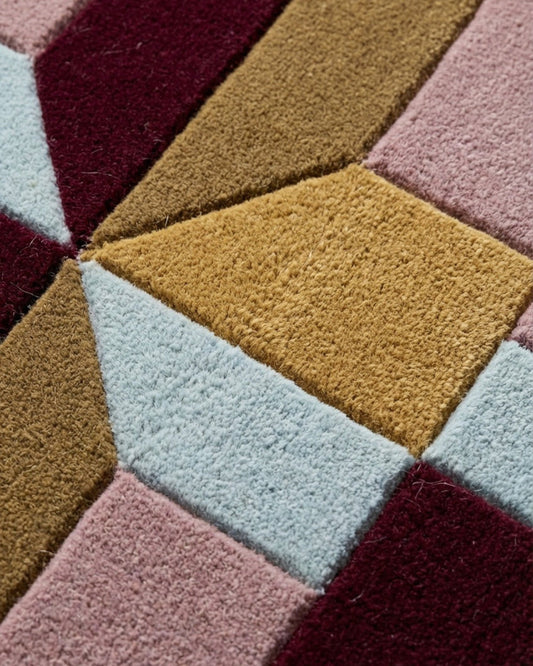
Two parameters govern this feel. First, pile height: a longer pile envelops the foot more. Then, tuft density: the tighter the tufting stitches, the firmer and more durable the pile, and the better it resists the marks of repeated foot traffic. A hand-tufted rug makes it possible to play precisely on these variables, adjusting density and height to the intended use.
Choosing a rug for its comfort as much as for its design
These properties combine differently from room to room. In an open living room with generous volumes, a rug of a good size noticeably calms reverberation and makes conversations easier to understand. In a bedroom, wool tempers a cold floor and softens every first step of the day. Under a dining table, a dense pile absorbs the back-and-forth of chairs while reducing their noise.
Wool combines these qualities without any special treatment, because they stem from its structure. A contemporary hand-tufted rug then becomes an element of comfort in its own right, just like lighting or furniture. The chosen pattern dresses the room; the material, for its part, works silently to make it more livable.