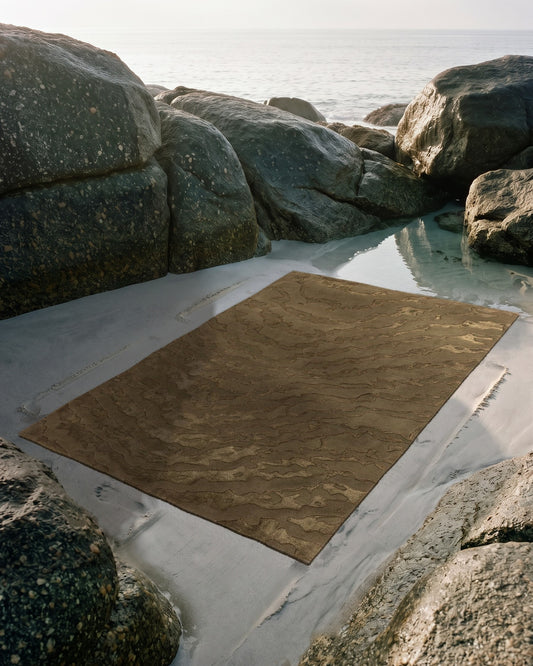
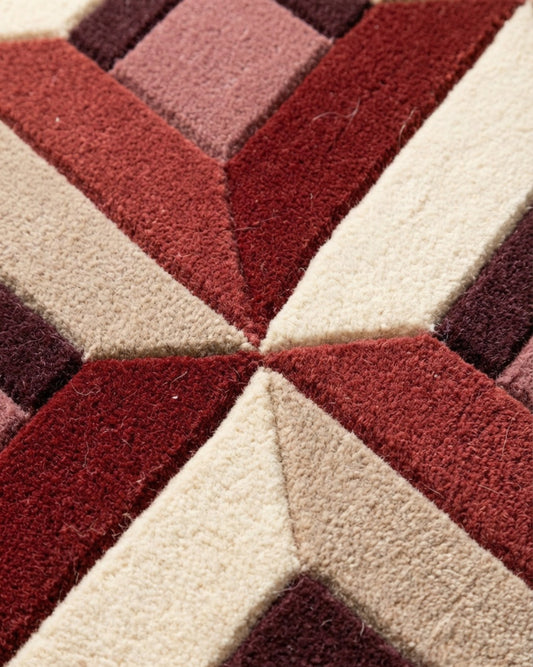
A wool and silk rug is preserved through regular, measured care. Vacuum in the direction of the pile without a rotating brush, turn the rug twice a year to even out wear and light, blot stains without rubbing, and always let it dry flat, away from direct heat. Wool cleans easily; silk calls for more restraint.
A hand-knotted or hand-tufted rug in New Zealand wool and silk is not a fragile object, but a living textile that responds to light, humidity and foot traffic. Wool, an animal keratin, has a scaled structure that naturally repels dust and recovers its shape after compression. Silk, a protein filament far finer, catches light through its smooth surface and gives off the shifting reflections that give it its value. Caring for such a rug means understanding how these two fibers behave and adapting your care accordingly.
The calendar of the seasons offers a good reference point. Each change in household rhythm, from winter heating to the open windows of summer, alters the fiber's environment. Taking this into account makes it possible to anticipate rather than repair.
Vacuuming without harming the fiber
Vacuuming is the most frequent gesture, and the most poorly executed. The dust that builds up at the base of the pile acts as an abrasive: with every step, mineral particles nick the fiber and dull the colors. Vacuuming regularly, once or twice a week in high-traffic areas, prevents this silent process.
The essential rule concerns the rotating brush. On a tufted rug, the beater bar spins at high speed and tears off the tips of the pile, causing pilling and, on silk, an irreversible felted look. Switch off this function or use a smooth nozzle. Vacuum in the direction of the pile, never against it, and reduce the suction power on rugs with exposed silk, whose strands can be sucked up and broken.
Fringes, where there are any, should not be vacuumed head-on: they get caught in the brush and tear. A sweep of the hand along the edge is enough to free them.
Rotation, a step too often forgotten
A rug ages unevenly. Under a window, light slowly fades vegetable and synthetic dyes; in front of a sofa, foot traffic crushes the pile; elsewhere, the wool keeps its original luster. Without intervention, these differences become visible after a few years and lock the rug into asymmetrical wear.
Turning the rug 180 degrees twice a year, ideally in spring and fall, redistributes these stresses. The area exposed to light changes, traffic paths shift, and the surface keeps an even tone. This simple step extends the life of the rug more than any care product.
Use this rotation to inspect the back. A hand-tufted rug has a coated backing that holds the tufts in place; any distortion, residual moisture or sign of insects shows up first on the back. It is also the moment to briefly vacuum the reverse side to dislodge the fine dust that passes through the weave.
Treating a stain: speed matters more than the product
When an accident happens, the reflex counts more than the cleaner. Wool has a natural advantage: residual lanolin and its scaled structure slow the penetration of liquids. You therefore have a few minutes to act before the stain migrates to the core of the fiber.
Blot immediately with a clean white cloth, dabbing from the edge toward the center so as not to spread the area. Never rub: rubbing opens the wool's scales, felts the surface and drives the pigment deeper. For a water-based stain, cold water with a drop of neutral soap is usually enough. Avoid hot water, which sets proteins, and rule out alkaline or chlorine-based stain removers, which dissolve dyes and weaken the keratin.
Silk allows no improvisation: on a set-in stain, it is better to entrust the rug to a specialist cleaner than to risk a permanent ring.
Silk reacts badly to water, which can leave rings and stiffen the strand. Limit yourself to dry blotting and a professional's advice. On rugs that combine wool and silk, the silk portion, often used to highlight a motif or a sculpted relief, calls for this extra caution.
Drying and living with the rug throughout the year
After spot cleaning, drying determines the final result. Always let the rug dry flat, at room temperature, blotting excess moisture with a dry cloth. A direct heat source, a radiator or a hair dryer, contracts the fiber unevenly and can make the dye bleed. Prolonged direct sun fades as much as it dries: choose a well-ventilated, shaded room.
Humidity calls for seasonal vigilance. In winter, heating dries the air, and wool, which naturally regulates ambient humidity, loses some of its suppleness; a stable humidity level in the room benefits it. In the warmer months, regular airing prevents mold in the protein fibers and keeps away moths, whose larvae feed on keratin. Moving the rug, vacuuming both sides and briefly exposing it to the air limits this risk without chemicals.
Finally, a non-slip underlay protects the back from friction against the floor and cushions foot traffic, which preserves the density of the tufts. Well cared for, a wool and silk rug lasts through the decades: the wool develops a soft patina, the silk keeps its sheen, and the pattern stays as crisp as on the first day.