From relief to commission: thinking about carving when conceiving a custom pattern
· 4 min read
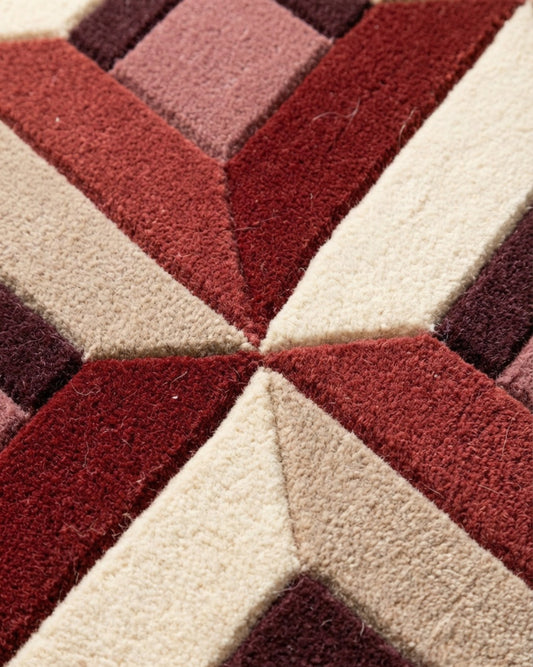
Carving sculpts relief directly into the wool by cutting the pile to different heights. For a custom pattern to show it to advantage, it must be drawn from the start around clean contours and surfaces wide enough for the artisan's hand to cut a real change in level. Relief is decided at the design stage, not afterward.
The relief of a rug is not added like a finish. It arises from the design itself, from the lines drawn in it and the areas set aside. When you compose a pattern in Studio Rugier, carving, the technique of cutting the wool to different heights to hollow out a relief, requires anticipating very early how the artisan's hand will work on the surface. A good relief pattern is conceived from the very first lines.
Carving extends tufting: once the wool loops have been inserted into the backing cloth and then sheared, the artisan goes back over certain areas with shears to hollow out grooves and bevels. We have detailed this work in our article on carving, the art of sculpting relief in wool. What matters for design is that relief lives on the difference in height between two neighboring areas of pile.
Why relief is decided at the drawing stage
The temptation is to draw a pattern first, then imagine where to carve afterward. The reverse order gives better results. Carving reveals forms through the shadows they cast: a cut edge catches light on its crest and sinks into shadow at the bottom of the groove. A design conceived for relief therefore organizes its masses with this raking light in mind from the outset, like a sculpted bas-relief rather than a flat image.
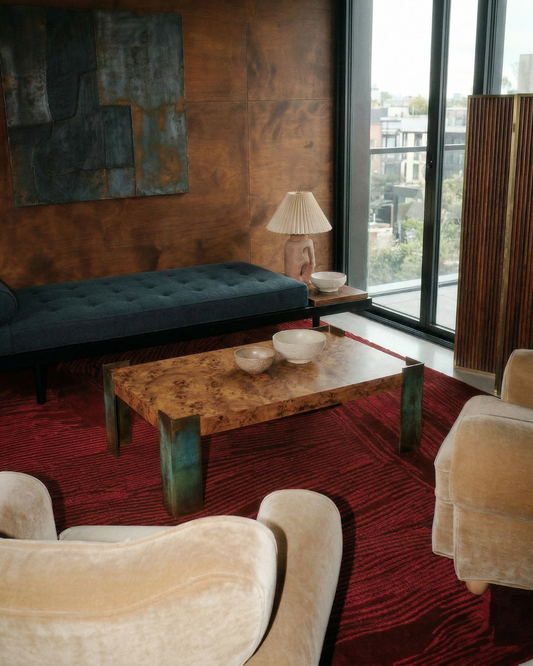
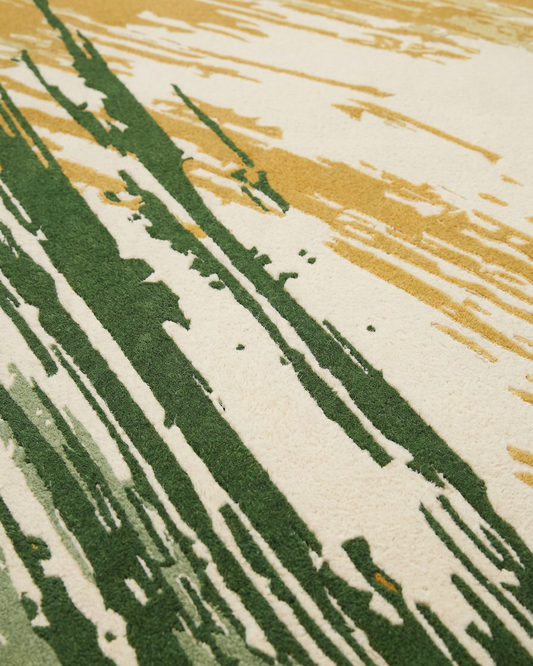
The La Pintura collection rests entirely on this principle. Its patterns are drawn so that the sculpted shearing underlines a contour, detaches a form from the background or hollows out a painterly gesture. Designs like El Rojo or Giallo show how a plain surface gains body as soon as a relief inscribes a clean line on it.
Shearing height, the first constraint of the design
Relief is measured in millimeters of difference in level between the high areas and the low areas. This range has limits: too slight, and the relief disappears in daylight; too great, and the edges fray and the design loses sharpness. The artisan therefore works within a range of heights that determines the scale of the pattern. A line in relief needs a certain width to exist, just as a groove that is too narrow does not hold shadow.
This concretely shapes the design. Tiny details, tight hatching and fine lettering do not lend themselves to carving: they would demand a precision of cut that shears cannot achieve without weakening the pile. A pattern conceived for relief favors ample forms, bold contours and areas generous enough for a change in level to read clearly. Our guide to choosing a pattern scale for the size of the room applies here with particular force.
The legibility of contours
Carving follows a line. Each time the design changes height, the artisan cuts a groove by hand along a contour. A clear, continuous line, without overly sharp angles or needless detours, can be cut cleanly. A confused contour, on the other hand, forces repeated passes and leaves irregular edges. The rule is simple: a relief pattern must remain legible when reduced to its contours alone, without color.
This discipline is in line with the logic of a constructed design, the one we explored with regard to De Stijl and composition reduced to the essentials. The less the design relies on decorative details, the more clean edges it offers carving to sculpt. Relief rewards structural clarity.
A pattern designed for relief can be recognized by this: its drawing stands on its own in black and white, through its contours alone, before any color or shadow is added.
Composing a relief pattern in Studio Rugier
When designing your rug, it helps to separate two decisions mentally: the drawing of the forms on the one hand, the areas of relief on the other. You can then reserve carving for the contours you want to bring out, leave certain areas perfectly flat for contrast, and play on the alternation between high pile and carved pile. This dialogue with the workshop is prepared from the composition stage, as our article on composing a rug with the tufters of Bhadohi recounts.
Material also comes into play. New Zealand wool, dense and resilient, holds the relief and keeps its edges over time, as we explain in the article on New Zealand wool as the benchmark for tufted rugs. Silk, softer and shinier, can mark a contrast of light between two levels, but it calls for wider contours so as not to flatten the relief. The choice of material is therefore part of the design, just like scale or palette.
Thinking about carving from the moment of ordering means accepting that relief imposes its grammar on the design, and making it a strength. A unique pattern gains depth when it has been conceived for raking light and for the hand that will cut it. All that remains is to open the collection of Rugier rugs to see what relief brings to a design, then to compose your own.