Studio Rugier is an online design tool that lets you compose your own rug: choose an existing harmony, import a pattern, start from a Rugier design or build from scratch. The result generates an instant quote and a file ready for hand tufting in Bhadohi, India.
Designing a rug was long a matter of slow dialogue between a client and a workshop: sketches sent back and forth, wool samples, exchanges by mail. Studio Rugier takes up this logic of custom work and carries it into a digital space, without betraying its spirit. The tool is meant as much for the decorator looking for a specific piece for a project as for the private individual who wants to watch a rug that did not exist come to life before their eyes.
Behind the interface, the promise comes down to a simple idea: putting into everyone's hands the decisions that until now belonged to the workshop. Size, palette, material, pattern. Each of these choices changes the piece in real time, and each one involves concrete know-how, that of the artisans who hand-tuft New Zealand wool and silk.
Four ways into the creative process
The Studio offers several entry points, designed for different needs and temperaments. The first consists of picking from color harmonies that have already been composed. These combinations are not put together at random: they rest on proven color principles, bold complementaries, measured tone-on-tone schemes, value contrasts, inherited from the pictorial tradition and from textile design. For anyone hesitating in front of a blank page, it is a solid starting point.
The second entry point is import. You can upload a drawing of your own, a personal motif, a sketch, and see it translated into the language of the rug. This option is of particular interest to interior designers and creators who wish to extend a graphic identity all the way to the floor, or to adapt a motif specific to a place.
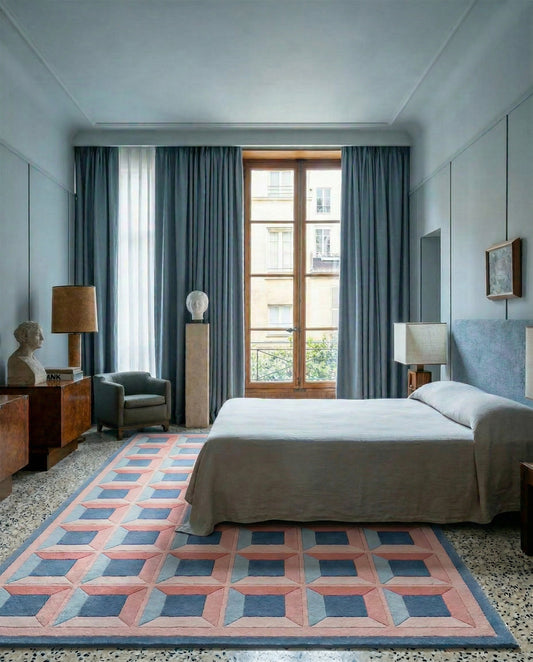
The third approach starts from the Rugier catalog itself. The designs in the collections, whether the illusions of Optical Palazzo, the sculpted reliefs of La Pintura or the undulations of Moire, can be taken up and then modified. You change a color, adjust a scale, reframe a composition. The house's heritage becomes a living working base rather than a fixed set.
For those who want full control, the toolbox offers a manual mode in which every shape, every shade and every proportion is set by hand. This is the territory of controlled compositions, where you place an interval, decide on a repetition, balance the masses. The vocabulary is that of geometric design, the one that the Bauhaus and De Stijl formalized at the start of the 20th century: line, plane, primary color, the relationship between solid and void.
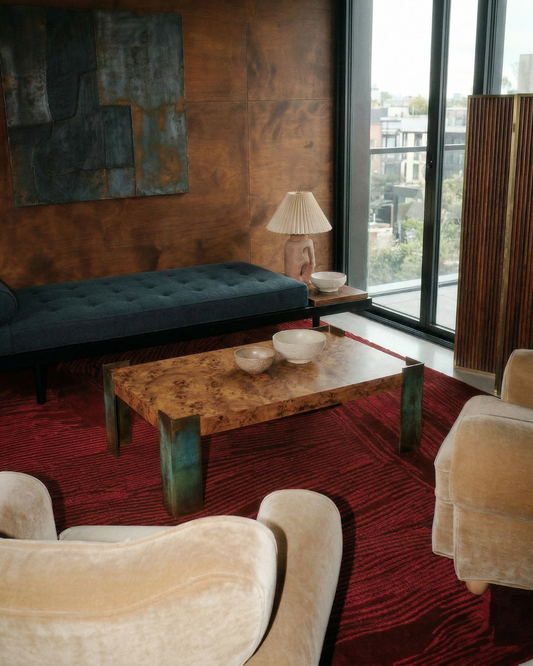
Random mode follows an opposite and complementary logic. In a few clicks, it generates unexpected proposals, combinations you would not have imagined on your own. This generative dimension recalls a method dear to many 20th-century artists, from Op Art to serial experiments: introducing a measure of controlled chance to outwit the habits of the eye. You run it, you observe, you keep one direction, then you take it back into your own hands.
Custom work is not a technical luxury; it is a way of deciding for yourself on the object that will inhabit a room for years.
From the drawing on screen to the strand of wool
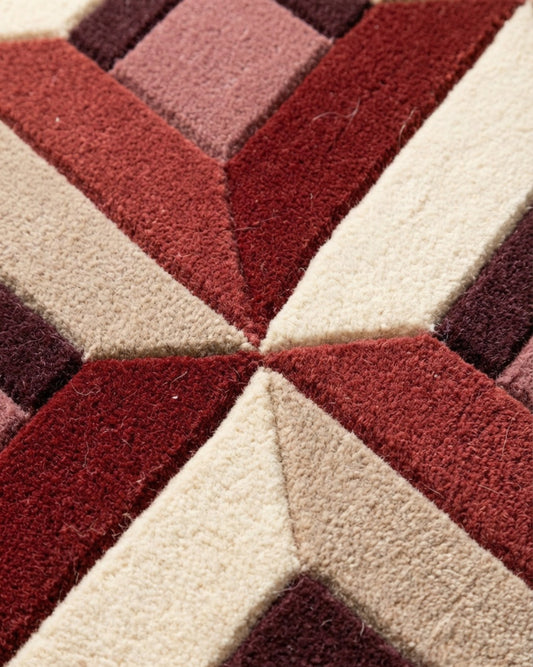
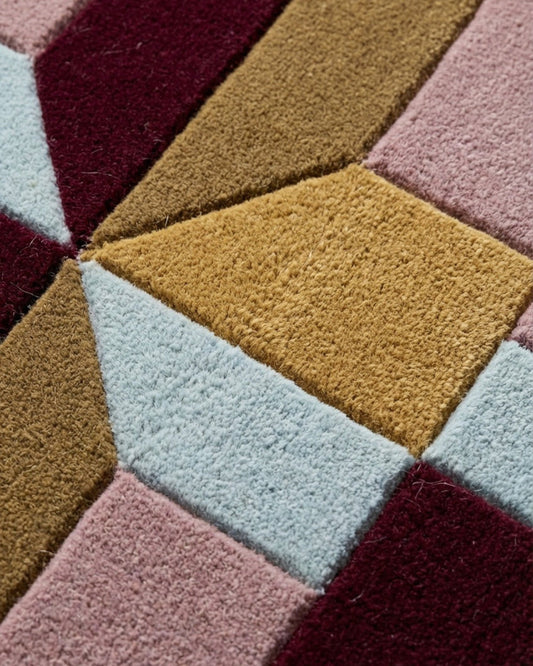
A rug is not an image: it is a tufted material, with thickness, density, texture. The Studio takes this reality into account. Choosing between wool, silk and blends does not only change the visual rendering on screen; it shapes the actual production. New Zealand wool brings body and depth to the color; silk catches the light and makes the reliefs stand out. These characteristics matter all the more in the collections where carving sculpts the pattern into the depth of the pile.
Once the composition is finalized, two outputs are produced. First, an instant quote, which gives a clear view of the project without waiting. Then a production file, which the workshops can use directly. This document translates the choices made on screen into precise instructions for the artisans of Bhadohi, the world capital of the handmade rug, where tufting know-how is passed down from generation to generation.
A dialogue with the artisan, at a distance
What happens in the Studio goes beyond assembling colors and shapes. It is a deferred dialogue with the hand that will tuft the wool. Each decision made on screen becomes an instruction for a real artisan, in a workshop certified by GoodWeave, a guarantee of production that respects working conditions. The resulting rug carries both the intention of the person who drew it and the gesture of the person who made it.
This is how custom work regains its full meaning. Composing a piece in Studio Rugier means taking part in a chain of creation that runs from the screen to the strand of wool, and leaving with an object whose every choice you know. The rug stops being a product picked off the shelf and becomes a design decision, considered, drawn, then tufted by hand.